Finding your betta motionless on the gravel is alarming the first time you see it. The good news is that bottom-sitting is often completely normal. The trick is knowing how to tell harmless resting from a genuine warning sign — so let’s break it down.
In this guide
Quick Answer: Normal Resting vs a Warning Sign
Here’s the single most useful test: gently approach the tank and watch your betta’s reaction.
- Probably normal if your betta is alert, perks up, and swims around when you come near — especially if it was sleeping, just ate, or is getting older.
- Worth investigating if it stays sluggish, has its fins clamped tight to its body, looks faded, struggles to swim, or is also refusing food.
In other words, a betta that chooses to rest on the bottom and pops up when something interesting happens is usually fine. A betta that can’t or won’t leave the bottom is telling you something is wrong.
When It’s Completely Normal
Plenty of bottom-sitting has a perfectly innocent explanation.
- Sleeping. Bettas sleep, and they often do it lying on the substrate, wedged in a plant, or draped over a leaf — particularly when the lights are off or the room is dim. A sleeping betta can look startlingly “dead” until it wakes up.
- Resting after a meal. Like a lot of animals, bettas slow down and settle after eating. A post-dinner rest on the bottom is nothing to worry about.
- Old age. As bettas get older they naturally become less active and spend more time resting. If your fish is a few years old and simply slowing down, that’s normal aging.
- It’s just their spot. Bettas have personalities. Some pick a favorite corner, cave, or leaf and lounge there. Their long, heavy fins also tire them out, so they rest more than slimmer fish.
If your betta is otherwise eating well, breathing normally, and looking bright and colorful, occasional bottom-sitting is just part of being a betta.
Sleeping or sick? A quick gut check. A sleeping betta breathes slowly and steadily, rests in a comfortable spot, and wakes up when you approach or the lights come on. A sick betta tends to breathe rapidly or heavily, holds its fins clamped tight, looks faded or patchy, and stays slumped on the bottom even when disturbed. When you’re unsure which one you’re seeing, the diagnostic below will settle it.
When to Worry — 6 Causes
If the bottom-sitting comes with other symptoms, work through these common causes.
1. Cold Water
This is the most frequent culprit. Bettas are tropical, and when the water drops below about 76°F their metabolism slows and they become lethargic — sinking to the bottom because they simply don’t have the energy to swim.
What to do: check your thermometer; you want a stable 78–80°F. If there’s no heater or the temperature is swinging, fix that first — see our betta water temperature guide. A cheap stick-on or digital thermometer lets you catch temperature drops before they leave your betta sluggish on the bottom.
2. Poor Water Quality / Ammonia
Invisible water problems are a leading cause of lethargy. As waste breaks down it releases ammonia, and if your tank isn’t cycled, ammonia and nitrite build to levels that poison and exhaust your fish, leaving it slumped on the bottom.
What to do: test your water with a liquid kit — ammonia and nitrite should both read 0 ppm. If either is high, do a 25–50% water change with dechlorinated, temperature-matched water right away.
3. Swim Bladder Disorder
The swim bladder controls a fish’s buoyancy. When it’s not working — usually from overfeeding or constipation — a betta can’t stay upright and may sink to the bottom, float oddly, or tilt to one side.
What to do: stop feeding for 1–2 days to let the gut clear, then offer smaller meals. A weekly fasting day helps prevent it. Persistent buoyancy trouble can signal a deeper issue.
4. Stress
Bettas are sensitive. A brand-new tank, aggressive or fin-nipping tank mates, constant bright light, or a tank with nowhere to hide can all stress a betta into hugging the bottom.
What to do: add plants and a cave for cover, dim harsh lighting, and reconsider any tank mates that might be bullying your betta. A newly bought betta will often rest more for the first few days while it adjusts, so give a new arrival a calm, quiet first week.
5. Not Eating + Lethargy
Bottom-sitting plus a loss of appetite is a stronger signal that something’s genuinely wrong, rather than your betta just having a lazy afternoon.
What to do: treat it as a troubleshooting situation — start with water and temperature, then work through the possibilities in our guide to why your betta isn’t eating.
6. Illness
A range of betta illnesses — fin rot, ich, dropsy, and bacterial infections — cause lethargy and bottom-resting. Look for accompanying clues: ragged fins, white spots, a swollen belly, raised scales, or labored breathing.
What to do: first rule out and fix water and temperature, since poor conditions cause most disease. If clear symptoms remain, see the “What to Do” and help sections below.
Quick Diagnostic: Find the Cause in 4 Steps
When in doubt, run through this simple check before doing anything drastic.
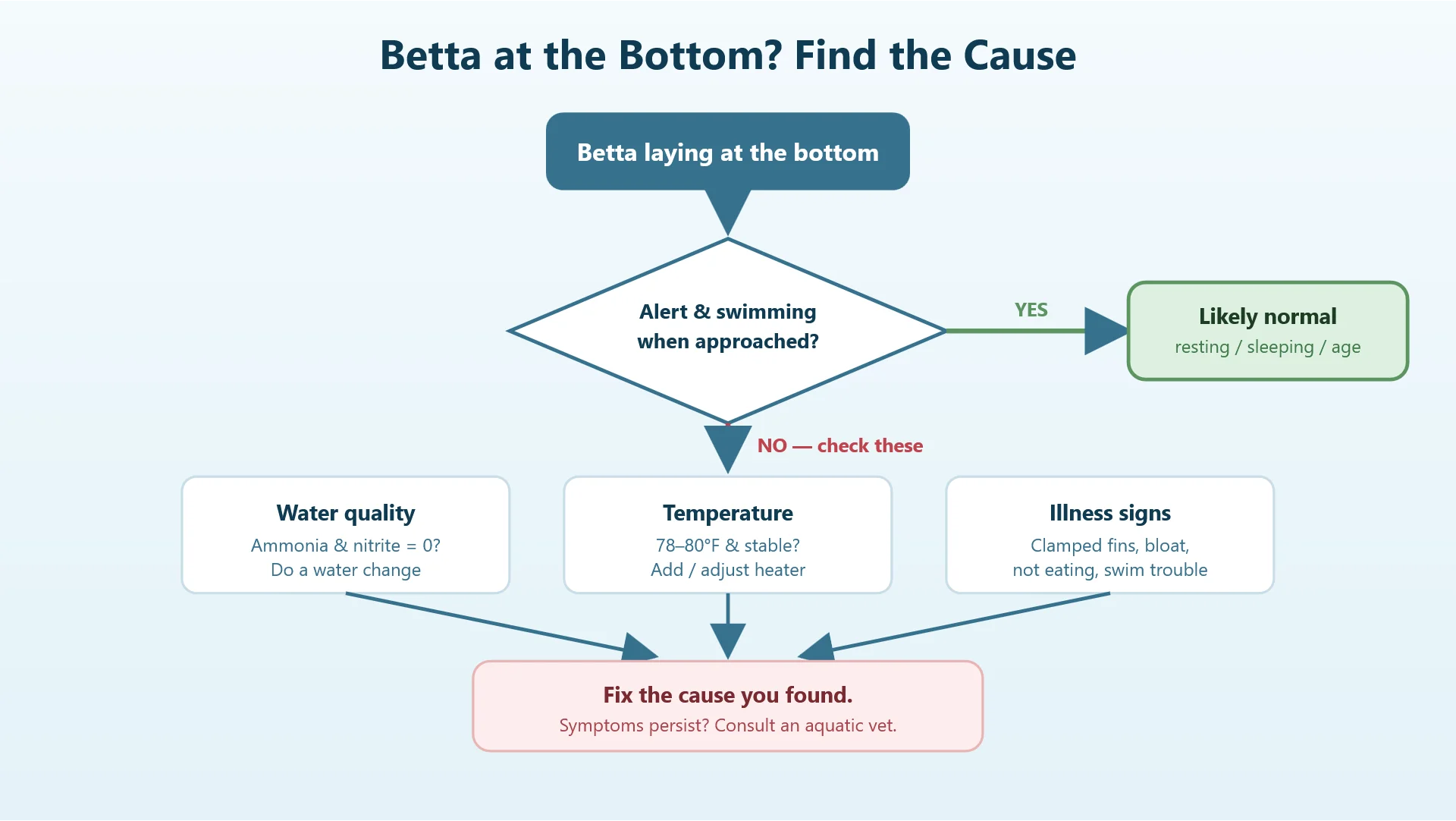
- Is your betta alert and swimming when you approach?
If yes, it’s most likely just resting — keep an eye on it.
- Test the water
— ammonia and nitrite should read 0 ppm.
- Check the temperature
— it should be a stable 78–80°F.
- Look for illness signs
— clamped fins, bloating, white spots, or trouble swimming.
Whatever the check turns up, fix that cause first. Most bottom-sitting traces back to temperature or water quality.
What to Do
Putting it together, here’s your action plan when a betta is parked on the bottom and you’re not sure why:
- Confirm it’s not just resting
using the approach test above.
- Test and correct your water
— a change brings ammonia and nitrite back to zero.
- Check the heater
— get the tank to a steady 78–80°F.
- Reduce stress
— cover, calm lighting, no bullying tank mates.
- Fast for a day or two
if you suspect overfeeding or a swim bladder issue, then feed smaller portions.
- Watch closely
over the next few days. If your betta perks up, you found it. If it stays down and shows clear symptoms, it’s time for help.
When to Get Help
See a vet when in doubt
Contact a qualified aquatic veterinarian if your betta stays glued to the bottom despite correct water and temperature, or shows clear signs of illness — a pinecone-like belly, white spots, ulcers, or persistent trouble swimming. Finned Friends can help you rule out the common causes, but we don’t diagnose disease — a professional is the right call when something looks seriously wrong.
FAQ
My betta is at the bottom and barely moving — is it dying?
Not necessarily. Many barely-moving bettas are simply asleep or cold. Check that it reacts when you approach, test your water, and confirm the temperature. If it’s unresponsive and showing other symptoms, treat it as urgent.
My betta is gasping at the surface and resting at the bottom — what’s wrong?
This combination often points to poor water quality (an ammonia spike) or a gill problem. Test your water immediately and do a water change with dechlorinated, temperature-matched water.
My betta sank to the bottom right after a water change — why?
A large or cold change, or forgetting dechlorinator, can briefly shock a betta. Make sure new water is temperature-matched and treated, and keep changes to around 25% at a time.
Why does my betta lie at the bottom at night?
That’s almost always just sleep. Bettas rest when it’s dark, often flat on the substrate or tucked into a plant, and they’ll perk back up in the morning. Keeping a regular day–night light cycle — and no harsh light after dark — helps your betta sleep soundly.
Is it bad for a betta to rest on the bottom a lot?
Not if it’s healthy and active the rest of the time — some bettas are simply lazy loungers. It only becomes a concern when the resting is near-constant and comes with a poor appetite, faded color, or clamped fins.
Most bottom-sitting comes down to temperature or water quality — so a heater, a test kit, and a weekly water change prevent the majority of cases. For the full picture, start with our complete betta care guide. 🐠

Maya Rivers
Maya Rivers has kept freshwater aquariums for over 15 years — everything from a single rescued betta to heavily planted community tanks. She started Finned Friends to give beginners the clear, calm answers she wished she'd had the night her first betta stopped eating. Every guide is researched against current aquarist and veterinary-informed sources and dated when it was last reviewed. Maya is an enthusiast and researcher — not a veterinarian — so when a fish needs medical help, Finned Friends always tells you to see a qualified aquatic vet.