It’s worrying to drop in food and watch your betta ignore it — but in most cases the cause is something simple you can fix. Let’s walk through what’s normal, the seven most common reasons, and exactly what to do about each one.
In this guide
Quick Answer: When Not Eating Is (and Isn’t) an Emergency
A betta skipping a meal or two is rarely a crisis. Bettas are small fish with small appetites, and a healthy adult can go several days without food and be perfectly fine. So if your fish missed today’s pellets but otherwise looks normal — swimming, alert, good color — don’t panic.
It’s more concerning when not eating comes with other symptoms: lying at the bottom and not moving, clamped fins held tight to the body, faded color, a swollen belly, white spots, or labored breathing. That combination points to a water or health problem worth investigating right away. Use the appetite as one clue, not the whole story.
- Probably fine if your betta is otherwise active, alert, and brightly colored — especially if it’s newly bought or was recently fed.
- Worth investigating if the refusal comes with lethargy, clamped fins, a swollen belly, white spots, or long stretches sitting at the bottom.
What Are Your Betta’s Other Symptoms?
A betta refusing food is one clue — the other symptoms tell you how worried to be. Match what you’re seeing to the most likely cause and your first move:
7 Reasons Your Betta Isn’t Eating
Most cases trace back to one of these, roughly in order of how often they trip up beginners. Work down the list and you’ll usually find the culprit.
1. It’s New or Stressed
If you just brought your betta home, a few days of disinterest in food is completely normal. Moving is stressful, and a new tank, new water, bright lights, or the presence of tank mates can all make a betta hide and skip meals while it settles in.
What to do: give it time — up to a week is fine. Dim the lights, keep the tank in a low-traffic spot, make sure there are plants or a cave to hide in, and avoid tapping the glass. Appetite usually returns once your betta feels safe. (For a calm start, see our full betta fish care guide.)
2. The Water Is Too Cold
This is one of the most common and most overlooked causes. Bettas are tropical fish, and when the water drops below about 76°F their metabolism slows down and their appetite fades. A cold betta becomes sluggish and simply doesn’t feel like eating.
What to do: check your thermometer. The target is a stable 78–80°F. If you don’t have a heater, or the temperature is swinging, that’s almost certainly your problem.
3. Poor Water Quality (Ammonia & Nitrite)
Water quality is invisible, which is exactly why beginners miss it. As fish waste and uneaten food break down, they release ammonia — and if your tank isn’t fully cycled, ammonia and nitrite build up to levels that stress and even poison your betta. A stressed, irritated fish stops eating.
What to do: test your water with a liquid test kit. Ammonia and nitrite should both read 0 ppm. If either is above zero, do a 25–50% water change with dechlorinated, temperature-matched water right away, and keep testing daily until levels are safe. A water conditioner such as Seachem Prime can temporarily detoxify ammonia between changes while your tank stabilizes.
4. The Food Is Wrong, Stale, or Boring
Bettas are carnivores and can be surprisingly picky. A few food-related culprits: pellets that have gone stale (they lose both scent and nutrients over time), a sudden switch to a new brand your betta doesn’t recognize, or simply a fish that’s bored of the same dry pellet every day. Bettas are also surface-oriented eaters with limited eyesight, so they may overlook food that sinks too quickly or drifts out of view.
What to do: offer some variety. Try frozen or freeze-dried treats like bloodworms, brine shrimp, or daphnia — most bettas find these hard to resist and it can kick-start a stalled appetite. Make sure your staple pellets are fresh (replace them every few months), and try soaking dry pellets for a moment so they sink and soften.
5. Overfeeding or Constipation
Sometimes a betta isn’t eating because it’s simply too full — or because too much food has left it constipated and bloated. Overfeeding is the single most common betta-care mistake, and a backed-up digestive system kills appetite fast.
What to do: stop feeding for 1–2 days to let your betta’s system clear, then resume with smaller portions — just 2–3 pellets per meal. A weekly fasting day prevents this from happening in the first place.
6. Illness
A loss of appetite is one of the first signs of many betta illnesses, including fin rot, swim bladder disorder, ich (white spots), internal parasites, and dropsy. Usually illness comes bundled with other symptoms — clamped fins, lethargy, bloating, raised scales, or unusual marks.
What to do: first, rule out and fix water and temperature problems, since poor conditions cause most illnesses. If your betta shows clear signs of disease, don’t try to guess a diagnosis — move to the “When to Get Help” section below.
7. Old Age or a Brumation-Like Slowdown
As bettas age, they naturally become less active and eat less — that’s normal and not a cause for alarm. Separately, a sudden drop in temperature or light can push a betta into a sluggish, semi-dormant state (similar to brumation), during which it eats little or nothing.
What to do: keep conditions warm, stable, and consistent. For an older fish, smaller and more tempting meals (like the frozen treats above) can help keep it interested.
Step-by-Step: What to Do Right Now
If your betta isn’t eating, work through these steps in order before doing anything drastic.
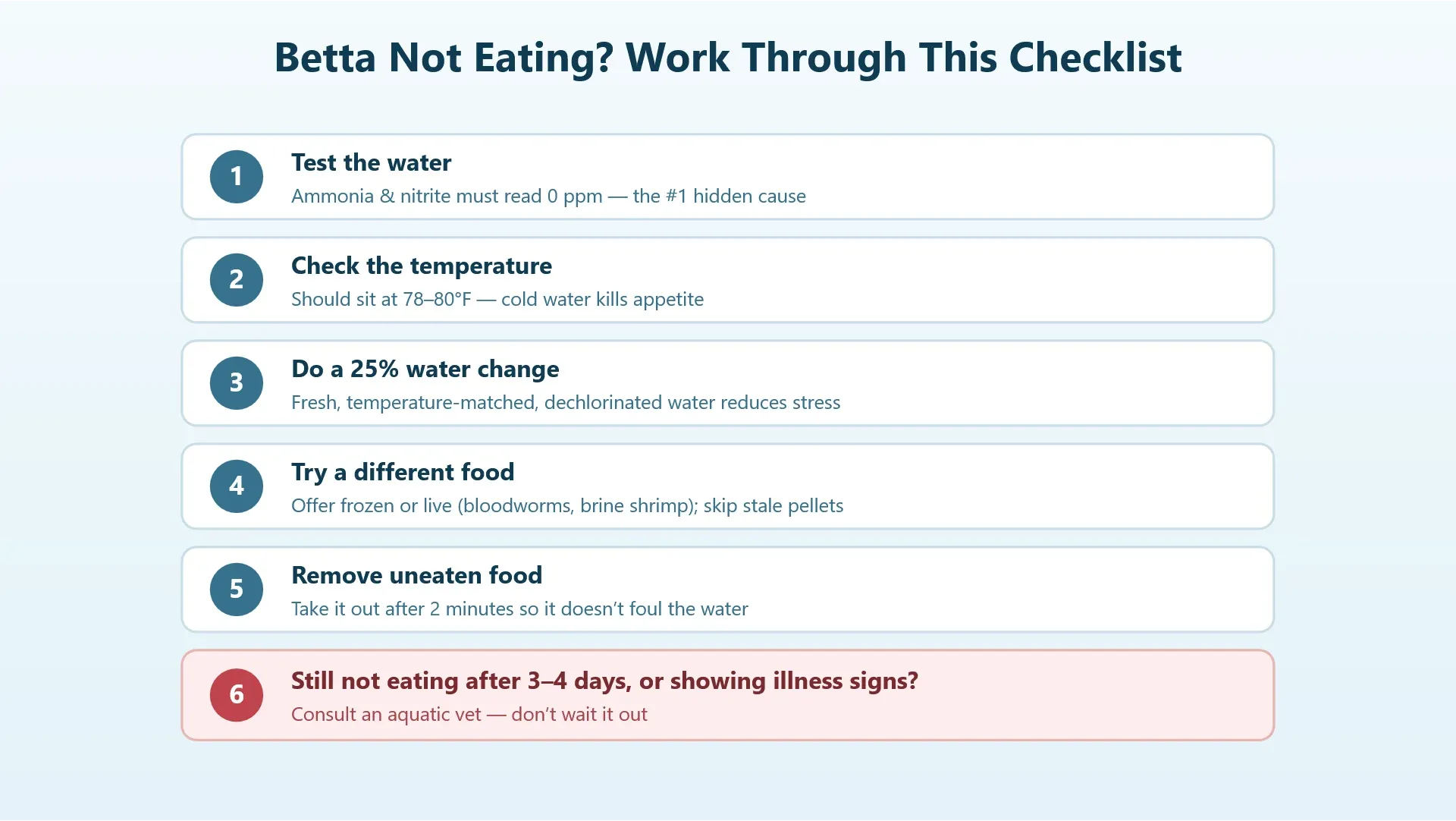
- 1 Test the water
— ammonia and nitrite must read 0 ppm. This is the number-one hidden cause.
- 2 Check the temperature
— it should sit at a stable 78–80°F.
- 3 Do a 25% water change
with fresh, dechlorinated, temperature-matched water to reduce stress.
- 4 Try a different food
— offer a frozen or freeze-dried treat instead of stale pellets.
- 5 Remove any uneaten food
after a couple of minutes so it doesn’t foul the water.
- 6 Watch for illness signs
— bloating, clamped fins, white spots, or lethargy.
- 7 Still not eating after 3–4 days, or showing symptoms?
Consult an aquatic vet — don’t wait it out.
How Long Can a Betta Go Without Eating?
A healthy adult betta can safely go several days — even up to about two weeks — without food and recover fully. This is why a weekly fasting day is a recommended part of betta care, not a risk.
That said, a long hunger strike is a symptom, not a goal. Use any missed days as a window to fix the underlying cause — almost always water temperature, water quality, or stress. Young, growing bettas have less reserve than adults, so don’t let a juvenile go as long without eating. If your betta is still eating even a little, take it as an encouraging sign — keep offering small amounts and focus on getting the tank conditions right.
When to Get Help
See a vet when in doubt
Reach out to a qualified aquatic veterinarian if your betta:
- Refuses food for more than about a week despite correct water and temperature, or
- Shows clear signs of illness — a bloated belly, scales sticking out like a pinecone, white spots, ulcers or sores, labored breathing, or persistent lethargy.
Finned Friends can help you understand and rule out the common causes, but we’re not a substitute for veterinary care. When something looks genuinely wrong, a professional is the right call — guessing with medications can do more harm than good.
FAQ
Q.My betta isn't eating and is lying at the bottom — what's wrong?
This combination usually points to a water or temperature problem, or sometimes illness. Test your water and check the temperature first.
Q.My betta stopped eating right after a water change — why?
A large or cold water change, or forgetting to add dechlorinator, can briefly stress a betta and put it off food. Make sure new water is temperature-matched and treated, and keep changes to around 25% at a time.
Q.My betta takes food then spits it out — is that normal?
Occasionally, yes — the piece may be too big. Try smaller pellets or soak them first. If it’s persistent and paired with bloating, it can signal a digestive issue, so a fasting day often helps.
Q.Why is my betta not eating and lethargic?
When a betta stops eating and turns sluggish at the same time, the cause is almost always its environment — most often cold water or a spike in ammonia or nitrite. Check that the temperature is a steady 78–80°F and test your water; ammonia and nitrite should both read 0. Fix those first. If the water and temperature are right and the lethargy lasts more than a few days, it may be illness, so watch for other symptoms and consider an aquatic vet.
Q.Why is my betta bloated and not eating?
A swollen belly with refusing food usually means constipation, often from overfeeding or dry food that wasn’t soaked. Fast your betta for one to two days, then offer a small piece of thawed daphnia, which acts as a gentle natural laxative. If the belly is swollen with raised, pinecone-like scales rather than a smooth bulge, that points to dropsy — a serious internal problem — so treat it as urgent and consult an aquatic vet.
Q.My new betta hasn’t eaten in three days — is that normal?
Yes, this is very common. A betta moving from a store cup into a new tank is stressed, and it’s normal for it to ignore food for the first several days — even up to a week — while it settles in. Keep the water warm (78–80°F) and clean, dim the lights, and don’t keep dropping in food that will rot. Offer a tiny amount once a day; most new bettas start eating within a week.
Q.Why won’t my betta eat pellets?
Bettas can be fussy about pellets, especially if the brand changed or the pellets are too big or stale. Try soaking them for a minute so they soften, switch to a smaller high-protein pellet, or tempt your betta with a frozen treat like bloodworms first, then reintroduce pellets. And make sure you’re not overfeeding — a portion no bigger than your betta’s eye is the usual rule of thumb, so two or three pellets is plenty.
Q.Why is my betta floating sideways and not eating?
Floating sideways, sinking, or struggling to stay upright usually points to a swim bladder problem, often linked to constipation or overfeeding. Fast your betta for a day or two, then feed a small thawed daphnia and keep portions tiny going forward. Lowering the water level slightly makes it easier to reach the surface to breathe while it recovers. If it doesn’t improve in a few days, or other symptoms appear, see an aquatic vet.
Q.Can I use garlic to get my betta to eat?
Many keepers do — soaking food in a little garlic juice, or using a garlic-based additive, can make it more appealing and may encourage a reluctant betta to eat. It’s safe to try, but treat it as a nudge, not a cure: if your betta still won’t eat, the real cause is usually water quality, temperature, or illness, so check those first rather than relying on garlic alone.
Sources & Further Reading
- Seriously Fish — Betta splendens — water temperature, parameters, and natural diet.
- PetMD — Betta Fish Care Sheet — DVM-reviewed health and feeding basics.
Once your betta is eating happily again, keep it that way with the right feeding routine and stable, warm water. For the full picture, start with our complete betta care guide. 🐠