Feeding a betta is genuinely simple — but it’s also where most new owners go wrong. Bettas will happily beg for food all day, and a well-meaning owner who keeps feeding ends up with a bloated, constipated fish in polluted water. Here’s exactly how often, how much, and what to feed so your betta stays lean and healthy.
In this guide
Quick Answer: The Simple Feeding Rule
If you remember nothing else, remember this: 2–3 pellets, once or twice a day, with one fasting day each week. A betta’s stomach is tiny — about the size of its eye — so it needs far less food than people expect. Anything more tends to do harm, not good.
How Often to Feed Your Betta
For a healthy adult betta, once or twice a day is ideal. Two small meals — one in the morning and one in the evening — mirror how a betta grazes in the wild and keeps its energy steady. Feeding just once a day is also perfectly fine, as long as the portion stays small.
What matters most is consistency and restraint. Feeding at roughly the same times each day helps your betta settle into a routine, and keeping portions small prevents the bloating that comes from constant snacking. Younger, growing bettas can handle slightly more frequent meals, while older, less active fish often do best on a single small daily feeding.
The weekly fasting day
Once a week, skip feeding entirely. A fasting day gives your betta’s digestive system time to fully process its food and clear out, which prevents constipation and the bloating that leads to swim bladder problems. This isn’t cruel — a healthy betta handles a day without food easily, and it’s one of the simplest things you can do to keep yours healthy. Many keepers pick the same day each week so it’s easy to remember.
How Much to Feed (the Eye-Size Rule)
Here’s the rule that prevents most feeding mistakes: a betta’s stomach is only about the size of its eye. That’s all the food it actually needs per meal — roughly 2–3 good-quality pellets.
A couple of things to watch:
- Pellets expand in water. Many betta pellets swell once they’re wet, so what looks like a small amount dry becomes much bigger inside your fish. Soaking pellets in a little tank water for a minute before feeding helps prevent bloating.
- Don’t trust the “I’m starving” act. Bettas are opportunistic feeders — in the wild they never know when the next meal is coming, so they beg constantly and will eat well past what’s good for them. A begging betta is not a hungry betta. Stick to the portion.
It also helps to watch your betta eat. Feeding by hand, a pellet or two at a time, lets you see exactly how much goes in and scoop out anything that drifts to the bottom uneaten before it can pollute the water.
What to Feed Your Betta
Bettas are carnivores. In the wild they eat insects, larvae, and tiny crustaceans — not plant matter — so their diet should be protein-rich and meaty.
- Staple: high-quality betta pellets. A pellet formulated specifically for bettas should be the foundation of their diet. Avoid using generic tropical flakes as a staple — they’re not designed for a betta’s needs.
- Treats: frozen or freeze-dried foods. Bloodworms, brine shrimp, and daphnia are excellent. Rotate them in a few times a week for variety and nutrition. Most bettas find them irresistible, which makes them handy for tempting a picky eater.
- A note on balance. Bloodworms are rich and best treated as an occasional treat rather than a daily meal. Daphnia, on the other hand, acts a bit like fiber and can actually help with constipation.
Here’s how the common foods stack up:
| Food | Role | Notes |
|---|---|---|
| Betta pellets | Daily staple | Protein-formulated specifically for bettas |
| Bloodworms (frozen/freeze-dried) | Occasional treat | Rich — a few times a week, not daily |
| Brine shrimp | Treat / variety | Highly palatable; great for picky eaters |
| Daphnia | Treat / digestion aid | Acts like fiber; helps prevent constipation |
| Tropical flakes | Avoid as staple | Not formulated for a carnivore’s needs |
Variety isn’t just about nutrition — it keeps mealtime interesting and your betta engaged and curious.
What NOT to Feed Your Betta
A few things do more harm than good:
- Human food — bread, crackers, and table scraps can’t be properly digested by a betta and just pollute the tank.
- Tropical flakes as a staple — an occasional option at best; they aren’t built for a carnivore’s needs.
- A bloodworm-only diet — too rich as a sole food and a common cause of constipation and bloating.
- Stale or expired food — old pellets lose nutrients and can upset digestion; replace opened containers every few months.
- Too much, too often — the most common mistake of all, covered next.
Sample Weekly Feeding Schedule
A simple routine takes the guesswork out of feeding. Here’s a balanced week:
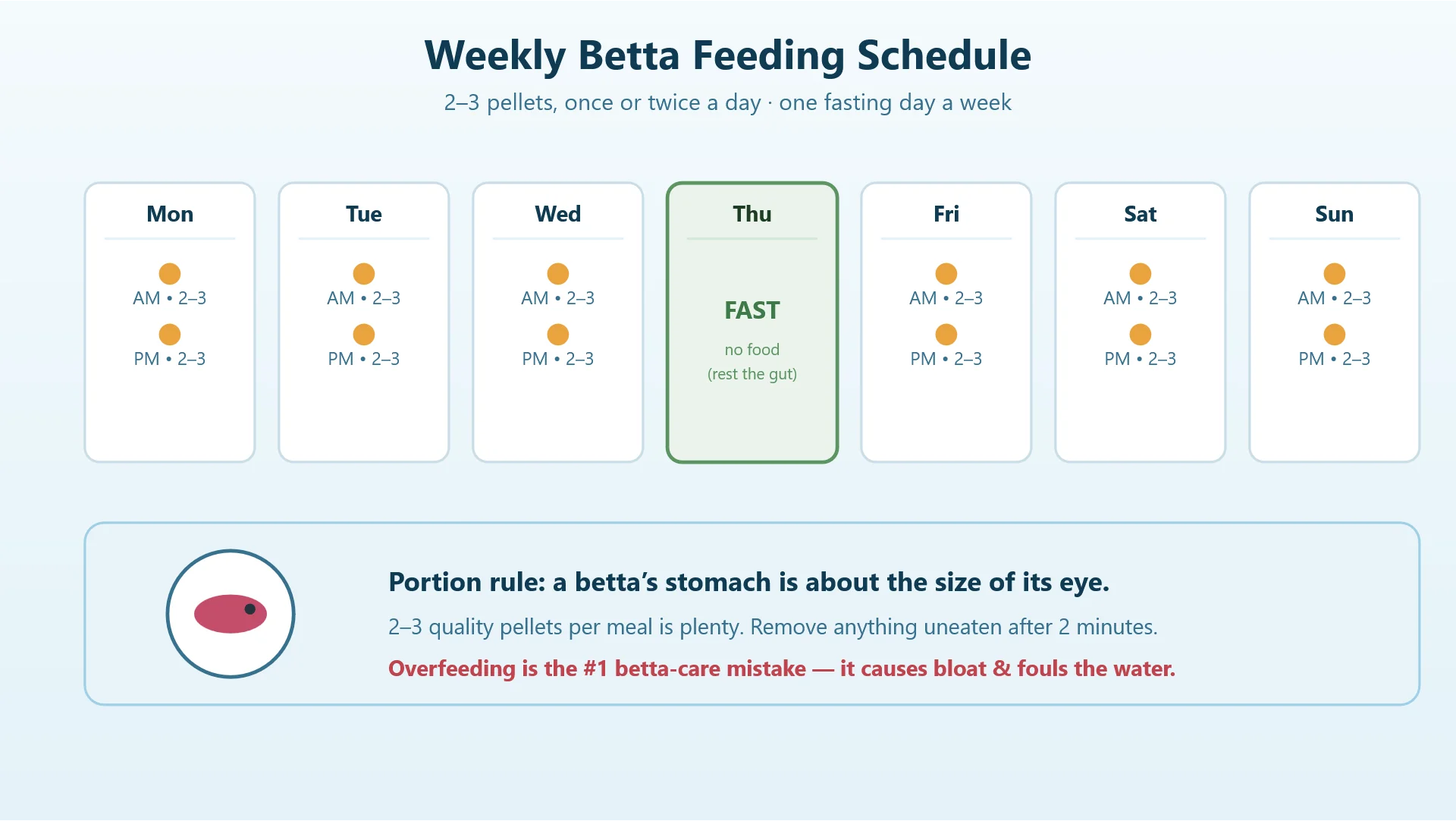
- Most days: 2 small meals (2–3 pellets each), morning and evening.
- A couple of days a week: swap one pellet meal for a frozen treat like bloodworms or brine shrimp.
- One day a week: fast — no food at all.
Adjust the timing to your own schedule; the exact days don’t matter as much as keeping portions small and including that weekly fast.
Signs You’re Overfeeding
Overfeeding is the single most common betta-care mistake, and it shows up in a few telltale ways:
- A bloated, swollen belly on your betta.
- Uneaten food sitting on the substrate after a couple of minutes.
- Cloudy or smelly water, and rising ammonia, as leftover food rots.
- Constipation — a betta that looks bloated, isn’t passing waste normally, or starts sitting at the bottom of the tank (more on that in our guide to why bettas lay at the bottom).
What to do: scale back to 2–3 pellets per meal, always remove uneaten food after a couple of minutes, and give your betta a fasting day (or two) to recover. Prevention is simply feeding less than you think you should.
Feeding Baby Bettas (Fry)
Young, growing bettas have different needs from adults. Fry are developing rapidly and burn through energy fast, so they need more frequent, smaller feedings — usually 2 to 3 times a day. They also need appropriately tiny, protein-rich foods such as baby brine shrimp or microworms to support healthy growth and fin development. As they mature, you can gradually shift them toward the standard adult schedule above.
FAQ
How long can a betta go without food?
A healthy adult betta can safely go several days — even up to about two weeks — without food. This is why a weekly fasting day is completely safe. If your betta is refusing food unexpectedly, though, that’s worth looking into — see why your betta isn’t eating.
How should I feed my betta while I’m on vacation?
For a trip of a few days up to a week, the simplest option is to let your betta fast — it’s safer than overfeeding. Avoid the 14-day “vacation feeder” blocks, which dissolve and foul the water. For longer trips, an automatic feeder set to tiny portions, or a trusted person given pre-measured amounts, works best.
Can you overfeed a betta?
Absolutely — and it’s the most common mistake. Overfeeding causes bloating, constipation, swim bladder problems, and polluted water. When in doubt, feed less.
My betta always acts hungry — should I feed it more?
No. Bettas beg constantly by nature; it doesn’t mean they’re underfed. Stick to 2–3 pellets per meal regardless of the puppy-dog eyes.
Do bettas need to eat every day?
Not strictly. Once a day is plenty, and one no-food day each week is actually good for them — skipping the occasional day won’t harm a healthy adult and helps prevent digestive trouble.
What’s the best food for a betta?
A high-quality pellet made specifically for bettas, used as the daily staple, with frozen or freeze-dried treats like bloodworms and brine shrimp a few times a week for variety. No single food does it all — a rotation keeps your betta healthiest.
Get the portions right and most betta health problems never start. Pair this routine with stable, warm water and you’re most of the way to a long, healthy life for your fish — see our complete betta care guide for the full picture. 🐠

Maya Rivers
Maya Rivers has kept freshwater aquariums for over 15 years — everything from a single rescued betta to heavily planted community tanks. She started Finned Friends to give beginners the clear, calm answers she wished she'd had the night her first betta stopped eating. Every guide is researched against current aquarist and veterinary-informed sources and dated when it was last reviewed. Maya is an enthusiast and researcher — not a veterinarian — so when a fish needs medical help, Finned Friends always tells you to see a qualified aquatic vet.