
If you’ve spotted a frothy patch of bubbles floating at the top of your betta’s tank, your first reaction might be worry — is something wrong with the water? In almost every case, the answer is a happy one. Let’s look at what a bubble nest is, why your betta built it, and the one situation where surface bubbles do mean you should check something.
In this guide
Quick Answer: It’s Usually a Good Sign
A bubble nest is one of the most reassuring things a betta owner can see. It’s a sign that your male betta feels healthy, comfortable, and secure enough in its environment to act on its natural breeding instinct. You don’t need to do anything about it — no cleaning, no removing, no worrying. It’s your fish telling you it’s content.
What Is a Bubble Nest?
A bubble nest is exactly what it sounds like: a raft of small bubbles clustered together at the water’s surface, usually in a calm corner of the tank or under a leaf or floating object.
Male bettas build them by gulping air at the surface and coating each bubble with a little saliva, which gives the bubbles a sticky, durable skin so they hold their shape and stick together. The result is a floating nursery — in the wild, a male betta uses the nest to hold and protect fertilized eggs until they hatch.
The nest can range from a thin scattering of bubbles to a thick, dense raft an inch or more across, depending on the individual fish and how motivated it is.
Why Bettas Build Them
Bubble-nest building is pure instinct. In the wild, male bettas construct these nests as part of the breeding process: they build the nest, attract a female, and once the eggs are fertilized, the male places them into the bubbles and guards them until they hatch.
Here’s the key point for you as an owner: a male betta will build a nest whether or not a female is anywhere nearby. It’s an instinctive behavior tied to feeling healthy and secure, not something that requires a mate. When the water is warm, clean, and calm, a male betta will often build nests simply because conditions feel right for breeding — which is exactly why a bubble nest is read as a sign of a well-kept, contented fish.
Several things tend to trigger a burst of nest-building: warm, clean water after a change, stable temperatures, calm surface conditions, and a male simply maturing into adulthood. Even shifts in weather and barometric pressure are thought to set some bettas off.
Do Female Bettas Make Bubble Nests?
Bubble-nest building is overwhelmingly a male behavior — it’s the males that build and guard the nest in the wild. Occasionally a female may produce a few stray bubbles, but a proper, deliberate bubble nest is something you’ll almost always see from a male betta. So if your betta is busy building, it’s a very good clue that your fish is male.
Should You Remove the Nest?
No — leave it alone. A bubble nest is harmless, natural, and a positive sign, so there’s no reason to clean it away.
If you’re not breeding your betta, the nest will simply drift apart on its own over time, and your betta may rebuild it again later. The only time it naturally breaks up is during water changes or if there’s surface movement — and that’s fine. There’s no need to preserve it or to remove it; just let your betta do its thing.
How Long Does a Bubble Nest Last?
There’s no set timetable. A bubble nest can last anywhere from a day to a couple of weeks, depending on the individual fish, the water conditions, and whether anything disturbs the surface. Left undisturbed, a male will often maintain and even add to a nest over several days. It usually breaks apart during a water change or from filter current — and that’s completely fine. Your betta will simply build another whenever the mood strikes, so don’t be surprised when nests come and go.
How to Encourage a Bubble Nest
If you’d like to see more nest-building (it’s a nice reassurance that your fish is thriving), the trick is simply to give your betta the conditions it associates with good breeding weather:
- Keep the water warm and stable. A steady 78–80°F encourages the behavior — see our betta water temperature guide.
- Use gentle filter flow. Strong current blows nests apart, so a low-flow filter helps. Our guide on whether bettas need a filter and heater covers choosing the right one.
- Keep the water clean. Regular water changes and good quality signal a healthy environment.
- Add a calm surface spot. A floating plant, leaf, or even a foam “betta hammock” near the surface gives your betta an anchor point to build against.
That said, don’t worry if your betta doesn’t build nests. Plenty of perfectly healthy bettas rarely bother — it varies a lot by individual personality.
When Surface Bubbles Are NOT a Nest
Here’s the one situation worth a second look. Not every bubble at the surface is a bubble nest. A thin, oily, or foamy film spread across the whole surface — rather than a tight cluster of distinct bubbles — can point to a water-quality problem instead.
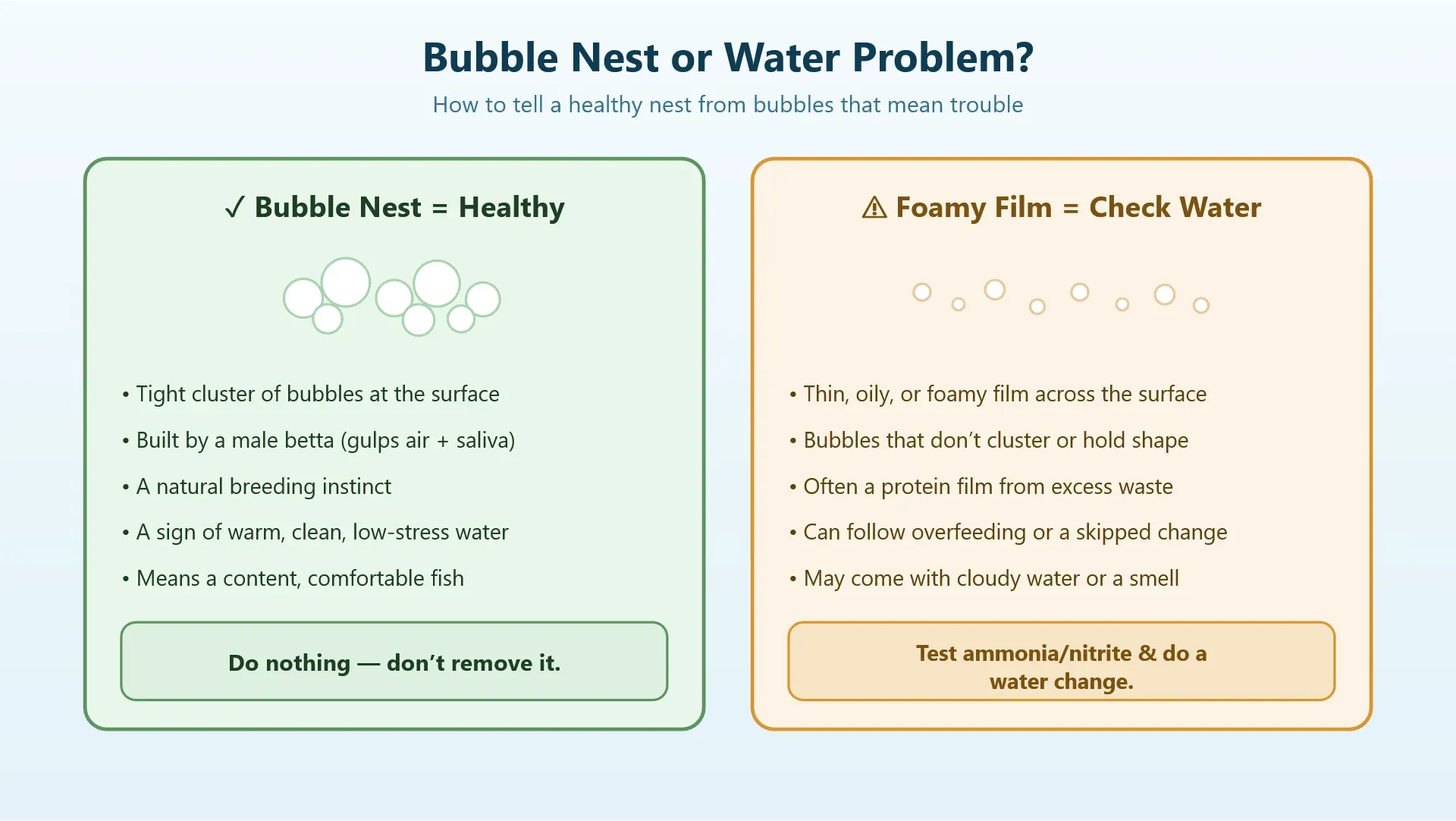
This kind of surface scum is often a protein film caused by excess waste, overfeeding, or a skipped water change. It may come along with cloudy water or a faint smell. Unlike a bubble nest, it doesn’t form a neat raft and doesn’t hold its shape.
What to do: if you’re seeing an oily film rather than a clustered nest, test your water (ammonia and nitrite should read 0), do a partial water change, and ease up on feeding. If your betta also seems off its food or lethargic, work through our guide on why your betta isn’t eating.
FAQ
Q.My betta built a nest but there's no female — is that normal?
Completely normal. Male bettas build nests on instinct whenever they feel healthy and secure, with or without a mate nearby. It’s a good sign, not a problem.
Q.My betta's bubble nest fell apart — did I do something wrong?
No. Nests naturally break up during water changes or from surface movement, and bettas build and abandon them all the time. Your fish will likely make another when it feels like it.
Q.My betta started blowing bubbles after a water change — why?
Fresh, clean water often inspires a burst of nest-building, since it signals good conditions. It’s another reassuring sign your betta is happy with its environment.
Q.Does a bubble nest mean my betta wants to breed?
It means your betta is healthy and instinctively ready to — but it doesn’t mean you should breed it. Breeding bettas is an advanced, demanding project. On its own, a nest is simply a sign of a happy, well-conditioned fish.
Q.Is a bigger bubble nest better?
Not necessarily. Nest size varies with individual personality and mood as much as with health. A small nest from one betta and a thick raft from another can both come from perfectly healthy fish — the nest’s presence matters more than its size.
A bubble nest is one of the easiest wins in fishkeeping — it means you’re getting the basics right. Keep the water warm, clean, and calm, and your betta will keep showing you it’s content. For everything else, see our complete betta care guide. 🐠