
Water changes are the single most important thing you do for your betta, and once you know your setup the schedule is genuinely simple. The trouble is that most guides give one blanket number — “change the water weekly” — without asking the two questions that actually change the answer: how big is your tank, and is it cycled? Answer those two and the schedule falls into place.
In this guide
- 01 Quick Answer: The Two Things That Set Your Schedule
- 02 How Often to Change Betta Water — Schedule by Tank Size and Setup
- 03 Why Betta Water Changes Matter (Waste, Nitrate and the Nitrogen Cycle)
- 04 How to Do a Betta Water Change — Step by Step
- 05 Common Betta Water Change Mistakes
- 06 Quick Recap
- 07 FAQ
- 08 Sources and Further Reading
Quick Answer: The Two Things That Set Your Schedule
Your water change frequency comes down to tank size and whether your tank is cycled. A cycled tank has grown a colony of beneficial bacteria that quietly process fish waste, so it needs less frequent changes. An uncycled tank — a brand-new setup, or a bowl with no filter — has no such safety net, so waste builds up fast and you change water more often to keep your betta safe.
If you remember nothing else: a filtered, cycled 5-gallon = ~25–30% weekly. Everything smaller, unfiltered, or not-yet-cycled needs more. To turn a percentage into an actual amount of water, our aquarium volume calculator gives you the exact gallons to start from.
How Often to Change Betta Water — Schedule by Tank Size and Setup
Three things move the number: tank size (more water dilutes waste more slowly to dangerous levels), filtration, and cycling status. Here’s the by-size breakdown most guides skip:
Bioload nudges these numbers: heavy feeding, tank mates, or a tank with no live plants all mean more waste, so change a little more often. Live plants pull nitrate out of the water, so they buy you a bit of slack. The honest way to dial it in is to test nitrate and aim to keep it under about 20 ppm.
Put simply: a filtered, cycled 5-gallon tank wants about 25–30% of its water swapped once a week. A 2.5-gallon unfiltered bowl is the hardest case — plan on 25–50% every 2–3 days plus a larger change weekly, because there’s almost nothing buffering the waste. A cycled 10-gallon is the easiest — its larger water volume means a gentle 20–25% weekly usually keeps everything in range.
Notice the pattern: bigger and cycled means less work. That’s not a coincidence — it’s the nitrogen cycle doing the heavy lifting.
Why Betta Water Changes Matter (Waste, Nitrate and the Nitrogen Cycle)
Your betta is constantly producing ammonia — from its gills, its waste, and any uneaten food rotting on the bottom. Ammonia is toxic even at low levels; it burns gills and stresses the fish. So the entire point of betta water management is keeping ammonia near zero.
In a cycled tank, you get that for free. “Cycled” means the tank has grown enough beneficial bacteria to neutralize waste on its own. Two groups of bacteria do it in sequence: ammonia-oxidizing bacteria convert ammonia into nitrite (still toxic), and nitrite-oxidizing bacteria then convert nitrite into nitrate, which is far less harmful at normal aquarium levels (UF/IFAS EDIS, Ammonia in Aquatic Systems). These bacteria live mostly in your filter media and on surfaces in the tank — not floating in the water itself. That detail matters, and we’ll come back to it.
Here’s the part guides get wrong: your filter doesn’t remove nitrate. The bacteria turn waste into nitrate and stop there. Nitrate just accumulates. The only practical way to get it back out of a home tank is to physically remove some water and replace it with clean water. That’s the real job of a water change — diluting built-up nitrate and replenishing the minerals your betta needs. (Live plants help by consuming some nitrate, which is why a planted tank can go a touch longer between changes.)
Cycled vs. Uncycled — Why It Changes Your Schedule
If your tank is not cycled — it’s brand new, or it’s an unfiltered bowl that never built a bacterial colony — there’s nothing converting ammonia at all. It builds up directly, and fast. That’s why an uncycled tank needs water changes every couple of days: you’re manually doing the job the bacteria would otherwise do. A cycled tank only needs you to mop up the leftover nitrate, which accumulates slowly — hence the relaxed weekly schedule. Same fish, completely different workload, decided entirely by whether your bacteria are established.
How to Do a Betta Water Change — Step by Step
A partial water change takes about ten minutes once you’ve done it a couple of times. Here’s the routine.
What You Need
- A bucket used only for the fish tank (never one that’s held soap or cleaners)
- A gravel vacuum / siphon (this does double duty: it removes water and sucks debris out of the substrate)
- A water conditioner / dechlorinator
- A thermometer to match temperature
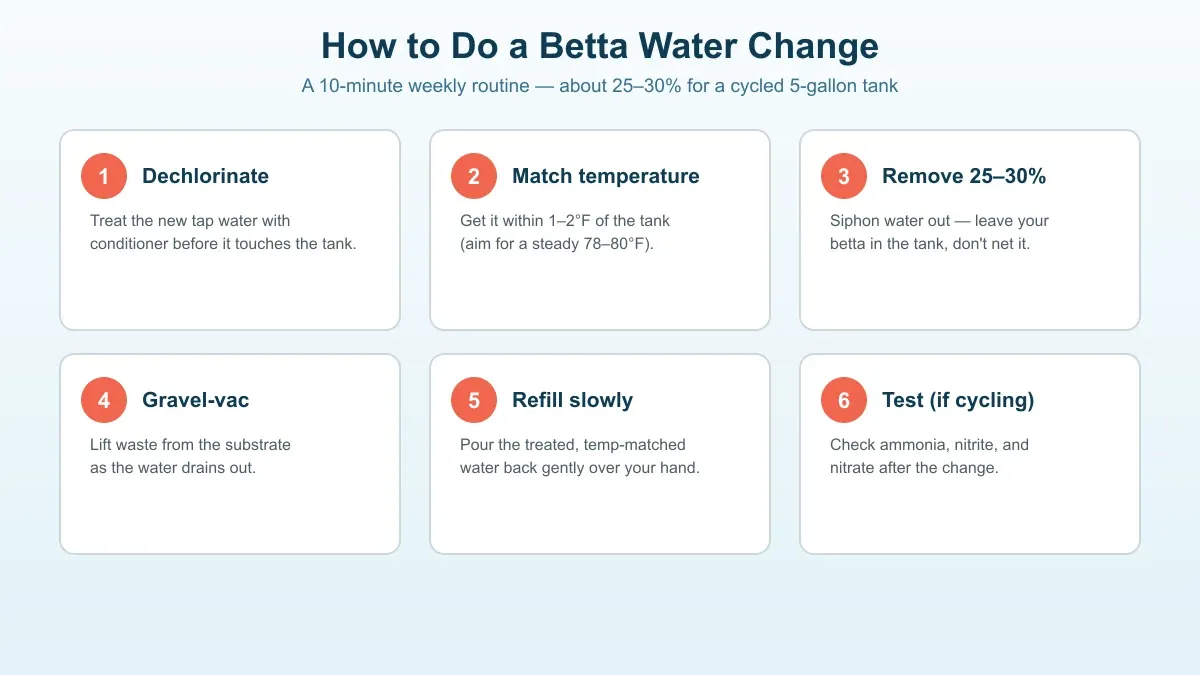
- 1 Prep and dechlorinate the new water
Fill your clean bucket with tap water and treat it with conditioner before it goes anywhere near the tank, following the dose on the bottle. Tap water in most areas contains chlorine or chloramine, which irritate a fish’s gills and kill the beneficial bacteria your cycle depends on. If you’re doing frequent large changes on an uncycled tank, choose a conditioner that also detoxifies ammonia. Don’t try to skip this by letting water “sit out overnight” — chloramine does not evaporate (Fritz Aquatics, About Chloramine).
- 2 Temperature-match
Get your new water within about 1–2°F of the tank (your betta should be sitting at a stable 76–82°F) before adding it. A thermometer in the bucket takes the guesswork out. Dumping in cold water shocks a betta and is one of the most common avoidable mistakes.
- 3 Remove the right percentage
Use the percentage from the table for your setup. Leave your betta in the tank for a normal partial change — netting and moving it is far more stressful than the change itself. Lower your siphon in and drain until you’ve removed your target amount.
- 4 Gravel vacuum as you go
While removing water, push the gravel vacuum gently into the substrate to lift out trapped waste and uneaten food. On a cycled tank, don’t deep-clean your filter media the same day, and never rinse it under the tap. If the sponge is genuinely clogged, give it a light squeeze in a cup of the old tank water you just removed.
- 5 Refill slowly
Pour the treated, temperature-matched water back in gently — over a plate, a cup, or your hand — so you don’t blast your betta with a current or a cold patch. Then restart your filter and heater if you paused them.
- 6 (Optional) Test
If your tank is new and still cycling, test ammonia, nitrite, and nitrate after the change so you can see whether you need to change again sooner. A liquid test kit is more accurate and cheaper per test than strips.
Common Betta Water Change Mistakes
- Doing a 100% water change on a cycled tank. This is the big one — but not for the reason you’ll usually read. The danger isn’t “washing away your bacteria”: those live in your filter media and substrate, not floating in the water, so swapping the water alone doesn’t crash a healthy cycle as long as the filter stays wet. The real problem is the sudden swing in temperature, pH, and hardness, which shocks your betta. Stick to partial changes. A near-full change is only justified for an unfiltered tank or to clear out medication — and even then, do it in two 50% stages and keep the filter media wet.
- Cold or untreated tap water. Temperature shock and chlorine/chloramine are two of the fastest ways to stress a betta. Always temp-match and always condition.
- Skipping the conditioner “just this once.” It only takes one untreated refill to damage gills or knock back your cycle.
- Over-cleaning the filter or vacuuming too aggressively on a young tank, before the bacterial colony is robust enough to bounce back.
- No schedule at all — relying on “it still looks clean.” Nitrate and ammonia are invisible. Clear water can be chemically unsafe, which is exactly why a calendar beats your eyes.
Quick Recap
Filtered and cycled 5-gallon: about 25–30% weekly. Smaller, unfiltered, or not-yet-cycled: more often — every 2–4 days. Always dechlorinate the new water, always match the temperature, and lean on a nitrate test rather than the way the water looks. Get those habits down and water changes become the easy, ten-minute routine that keeps your betta healthy.
For the full picture, start with our complete betta care guide — water changes are one piece of a stable, low-stress setup.
FAQ
Q.Can I change 100% of my betta's water?
Not on a cycled, filtered tank — though not because it “removes your bacteria.” Most of your beneficial bacteria live in the filter media and substrate, not in the water, so swapping the water alone won’t crash the cycle as long as the filter stays wet. The real problem is the sudden swing in temperature, pH, and hardness, which shocks your betta. Stick to partial changes. Only do a near-full change for an unfiltered tank or to clear out medication — and split it into two 50% stages to soften the swing.
Q.Do I need to remove my betta during a water change?
No. For a normal partial change, leave your betta in the tank — netting and moving it causes more stress than the water change does. Only move your betta (gently, into a cup of its own tank water) if you’re emptying nearly the whole tank.
Q.How often should I change betta water without a filter?
More often. Plan on a 25–50% change every 2–3 days plus a larger weekly change, because there’s no biological filtration breaking down ammonia for you. A filter and heater make betta care far easier.
Q.What percentage of water should I change for a betta?
For a filtered, cycled tank, 25–30% weekly is the sweet spot. Push toward 30%+ if your nitrate test reads high. Smaller tanks and unfiltered setups need bigger, more frequent changes — see the table above.
Q.Do I have to use water conditioner every time?
Yes — every time you add tap water. Conditioner neutralizes the chlorine and chloramine that would otherwise burn your betta’s gills and kill the beneficial bacteria in your filter. There’s no safe shortcut around it.
Q.How do I know if my betta tank is cycled?
It’s cycled when ammonia and nitrite both test at 0 ppm and you get a measurable nitrate reading — meaning bacteria are processing waste all the way through. Until you see that, test often and change water more frequently to stay safe.
Sources and Further Reading
- UF/IFAS EDIS — Ammonia in Aquatic Systems — the nitrogen cycle and why ammonia must stay near zero.
- Fritz Aquatics — About Chloramine — why chloramine doesn’t evaporate and conditioner is non-negotiable.
Once your routine is dialed in, the rest of good betta keeping gets easier too — the right tank size, a filter and heater, and a stable setup all reduce how hard your water changes have to work. For the full picture, start with our complete betta care guide. 🐠