Most setup guides stop at “get a heater.” This one gives you the wattage. It’s the buy list with real numbers attached — watts, gallons per hour, inches, dollars — plus the order to do things in, and a straight answer on when it’s safe to put the fish in.
For what each piece of equipment does and why a betta needs it, our complete betta fish care guide covers the fundamentals. This page assumes you’re past that and standing in the aisle deciding what to buy.
In this guide
- 01 The Betta Tank Buy List (What to Get, at What Spec)
- 02 What Size Tank Does a Betta Actually Need?
- 03 Heater, Filter, and Lid: the Three That Get Skipped
- 04 Substrate, Plants, and Decor That Won’t Tear Fins
- 05 Setting It Up, Step by Step
- 06 How Long Before You Can Add the Betta?
- 07 What a Betta Tank Costs
- 08 10 Common Betta Tank Setup Mistakes
- 09 Your Next Step
- 10 FAQ
The Betta Tank Buy List (What to Get, at What Spec)
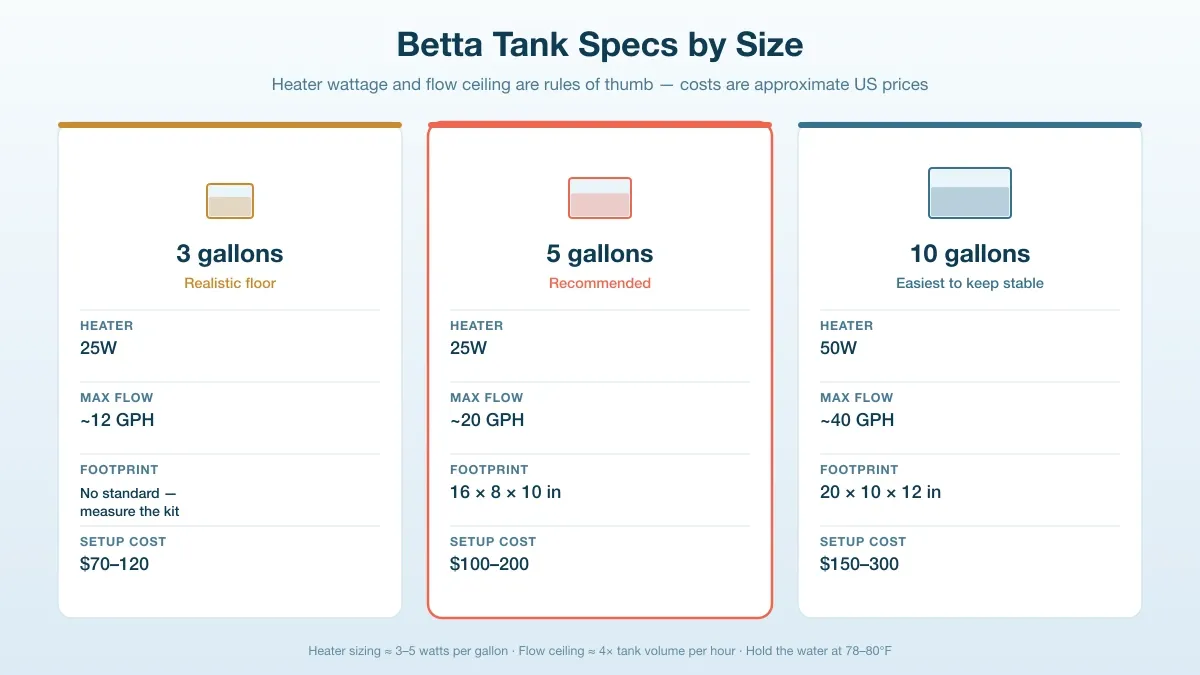
How to read that table. Heater wattage comes from the standard hobby rule of thumb of roughly 3–5 watts per gallon, sized toward the higher end for tropical fish like bettas and for cooler rooms. Treat it as a starting point you adjust: a tank in a 72°F living room needs less heat than the same tank in a 62°F basement. The flow ceiling comes from the common guidance that turnover shouldn’t exceed about 4× tank volume per hour for a long-finned, weak-swimming fish. Footprints are standard US glass aquarium dimensions and vary by a fraction of an inch between manufacturers, and by a lot more between kits. Not sure what an odd-sized tank actually holds? Measure it and run the numbers through our aquarium volume calculator.
The rest of the list, at spec: a lid; a separate thermometer (glass or digital, not a stick-on strip, and never the heater’s own dial); water conditioner; a liquid test kit covering ammonia, nitrite, nitrate and pH — liquid reagent kits resolve the low values that decide your go/no-go call more finely than strips do, and strips also degrade once the tub has been opened; an ammonia source for cycling — ammonium chloride, bottled nitrifying bacteria, or both; substrate, plants, a cave; and food for the day the fish arrives.
What Size Tank Does a Betta Actually Need?
Five gallons is the recommended starting point, three gallons is the realistic floor, and bowls are out.
The reason comes down to physics. Water volume is a buffer: a small body of water tracks room temperature faster, and the ammonia a fish produces reaches a dangerous concentration sooner when there’s less water to dilute it into. A 3-gallon isn’t just smaller than a 10-gallon, it’s less forgiving of every mistake you’ll make in your first six months. A bowl fails for a blunter reason: no room for a heater or filter at all.
Check the footprint column against your actual furniture. A 5.5-gallon at roughly 16 × 8 inches takes more desk than most monitor stands, and a 10-gallon at 20 × 10 inches won’t fit a narrow bedside table. Measure the surface first, and note that a filled 10-gallon is close to 100 pounds of water and glass alone, and nearer 120 once you add substrate. It needs furniture that can carry it.
Heater, Filter, and Lid: the Three That Get Skipped
These are the three items that don’t come in every kit and that beginners most often decide they can do without. All three matter.
The heater. Bettas are tropical, and the target is a stable 78–80°F. Buy adjustable with a built-in thermostat, and size it by the 3–5 watts-per-gallon rule of thumb: 25W for a 3- or 5-gallon, 50W for a 10-gallon. Two practical notes. First, don’t chase a bigger heater “to be safe” — an oversized heater in a small tank can create a hot pocket around the unit, and more seriously, if its thermostat ever sticks in the “on” position it can cook a few gallons far faster than you’d notice. Second, the number printed on the heater dial tells you what the heater is aiming for, not what your water is actually doing. Put a separate thermometer at the opposite end of the tank and trust that instead.
The filter. “Low flow” is the phrase every guide repeats without a number. The number is roughly 4× turnover per hour, so about 20 GPH in a 5-gallon. Small hang-on-back filters are commonly rated 40–100 GPH, which is two to five times more than that ceiling, so an off-the-shelf HOB usually needs modifying before it’s betta-appropriate.
The concrete fix is a waterfall baffle: cut a block of coarse filter sponge to the width of the filter’s outflow lip and wedge it into the opening, so the water seeps through the sponge instead of pouring into the tank. Aquarium Co-Op’s flow-reduction guide describes exactly this, plus several variations: craft mesh zip-tied across the waterfall opening, a suction-cup dish stuck to the glass under the waterfall and filled with marbles or moss balls to break the fall, a sponge slipped over the output to dissipate its energy, a spray bar, or simply aiming the output at the back wall. A pre-filter sponge on the intake tube does the other half of the job — Aquarium Co-Op’s separate guide to pre-filter sponges notes it stops fish and debris being pulled against the intake and grows beneficial bacteria on the extra surface area.
Or skip all of that and run a sponge filter on a small air pump. It’s cheap, it’s gentle by design, and there’s nothing to baffle. Or buy a nano HOB rated under about 20 GPH with a flow-control knob — several are sold specifically for tanks this size, and they need no baffling either.
The lid. Bettas jump, and a betta on the carpet is the most preventable way to lose one. You need a lid with a small gap for air exchange — bettas breathe atmospheric air at the surface through their labyrinth organ, so a fully airtight seal is not what you want.
Substrate, Plants, and Decor That Won’t Tear Fins
Substrate depth. For a bare-bottom or lightly planted tank, 1 inch of sand or smooth gravel is plenty and easier to keep clean. If you want rooted plants, go to 2 inches so roots have something to hold. Deeper than that in a small tank mostly just eats swimming volume. Rinse it in plain water until the water runs clear — never soap, on any piece of equipment, ever.
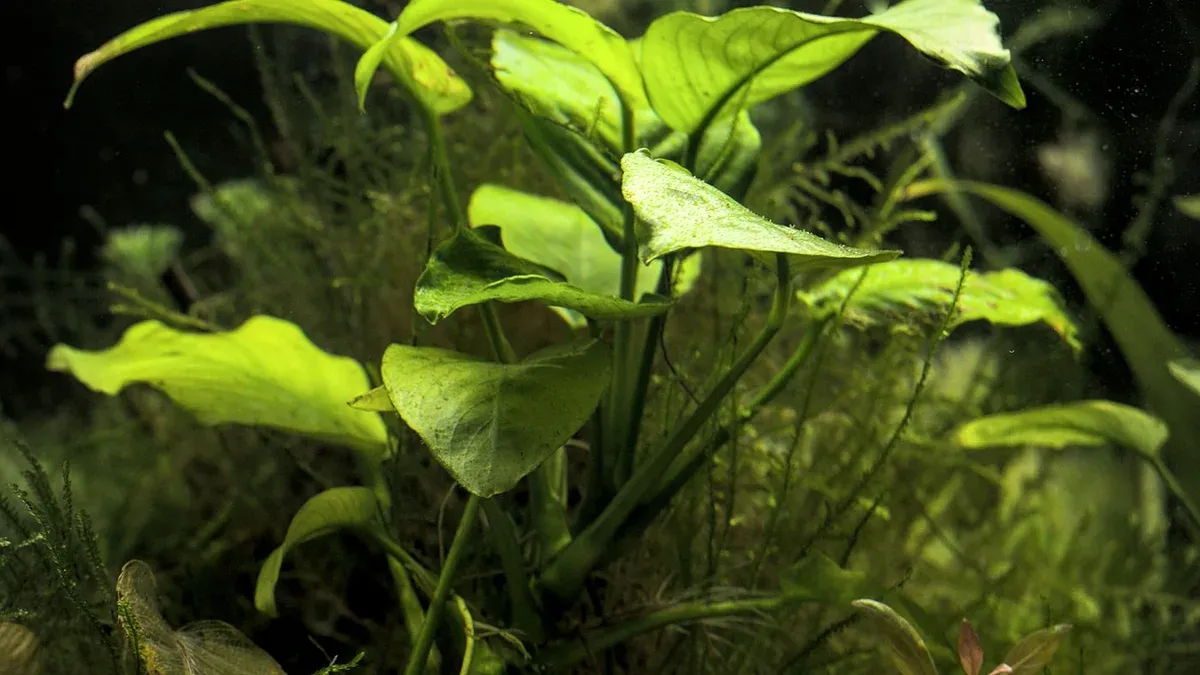
Plants. Three beginner-proof choices: anubias, java fern, and marimo moss balls. The first two attach to wood or rock rather than rooting, so they work in a bare-bottom tank and survive neglect. Broad leaves near the surface double as betta hammocks. Silk plants are a fine substitute; hard plastic ones are not.
One caveat on moss balls specifically: since 2021 US retailers have repeatedly found invasive zebra mussels hitchhiking on imported marimo, with contaminated stock traced across most of the country and fresh detections as recently as August 2024. Buy from a seller you trust, quarantine before the ball goes in a tank, and if you ever get rid of one, destroy it rather than putting it down a drain or in the garden.
The pantyhose test. Run a pair of pantyhose or a thin sock over every ornament before it goes in. If it snags the fabric, it will shred fins — this catches plastic plants, unglazed ceramic edges, and mold seams. Torn fins are an open door for infection.
The cave. One smooth, wide-mouthed hide with no sharp interior edges.
Setting It Up, Step by Step
- 1 Rinse everything in plain water
Tank, substrate, decor, plants. Never soap; soap residue kills fish.
- 2 Add substrate
Sloped slightly toward the front if you like the look.
- 3 Place hardscape and plants
After the pantyhose test. Do this before filling; it’s much easier dry.
- 4 Fill with dechlorinated water
Treat it with conditioner as you fill, or pre-treat it in a bucket. Chlorine and chloramine kill fish and also kill the beneficial bacteria you’re about to spend weeks growing.
- 5 Install the heater and filter
Submerge the heater fully, let it sit unpowered for 15–20 minutes to equalise, then plug it in. Set it toward the middle of 78–80°F.
- 6 Run everything for 24 hours
Check the thermometer at the far end of the tank. Adjust the heater dial until the thermometer reads 78–80°F, whatever the dial itself says.
- 7 Start the cycle
Add your ammonia source, and bottled bacteria if you’re using it. Now you wait, and test.
How Long Before You Can Add the Betta?
There is no date. There’s a test result.
Your tank is ready when a liquid test kit reads 0 ppm ammonia, 0 ppm nitrite, and some measurable nitrate. That’s the go/no-go rule, and it’s the only one worth trusting. A tank can hit it in two weeks or take eight. Any guide that promises you a specific number of days is guessing, because it can’t know your temperature, your ammonia dosing, or whether you seeded the tank with bacteria.
What you can reasonably expect, depending on method:
- Roughly the first one to two weeks. Ammonia climbs. Nitrite is still at zero or barely detectable. Nothing looks like it’s happening. This is normal.
- Somewhere in the middle stretch. Ammonia starts falling as nitrite climbs — the first real sign the tank is working. Nitrite typically peaks and holds for a while, and this is the phase that tests people’s patience most.
- Toward the end. Nitrite falls to zero and nitrate appears. When you can dose ammonia and see both ammonia and nitrite back at 0 ppm within 24 hours, the tank is cycled.
How long, overall? A fishless cycle typically runs 4–6 weeks, the same figure our betta care guide gives, and the standard figure in the hobby. Bottled nitrifying bacteria can shorten it substantially, sometimes to a couple of weeks or less. Be aware that the boldest numbers here — a cycled tank in under a week — come from the companies selling the bacteria, and results in practice vary with product, handling, and how long the bottle sat on a shelf. Treat bottled bacteria as a head start, never as a licence to skip testing.
Test every two or three days and write the numbers down. The pattern — ammonia up, ammonia down and nitrite up, nitrite down and nitrate up — tells you more than any single reading. Our pillar covers the nitrogen cycle theory behind that pattern if you want to understand what the bacteria are actually doing.
The rule, one more time: 0 ammonia, 0 nitrite, some nitrate. Not a date.
What a Betta Tank Costs
Approximate US prices as of 2026. These move with region, retailer, and time, so use them to plan a budget rather than to predict a receipt.
- Budget, around $70–120. An all-in-one 3- or 5-gallon kit with filter and lid, a separate 25W heater, thermometer, dechlorinator, liquid test kit, silk plants, and a hide.
- Mid, around $120–200. A 5- or 10-gallon tank bought separately, a sponge filter or baffled HOB, adjustable heater, sand, a few live plants. Most well-set-up beginner tanks land here.
- Premium, around $200–350+. A 10-gallon or larger, planted substrate, a decent light, hardscape, and better test equipment.
Component by component, current US retail runs roughly $25–100 for the tank, $10–50 for the filter (a sponge filter and air pump sit at the bottom of that, a hang-on-back nearer the top), $15–30 for an adjustable heater, and $25–35 for a liquid master test kit. Kits save money mainly by bundling tank, filter, and lid, and many don’t include a heater, which is the one item you can’t skip.
Most setup guides ranking for these searches are published by aquarium retailers, and they recommend kits. Kits aren’t bad, but a guide with a shopping cart attached has a reason to tell you that you need more than you do. The floor for a healthy betta is a heated, filtered, lidded, cycled tank of adequate volume. Everything past that is decoration, and decoration is for your benefit rather than the fish’s.
10 Common Betta Tank Setup Mistakes
- Bowls and unheated vases. No room for a heater or filter, and no volume to buffer anything.
- No heater. Room temperature is not 78–80°F, even in a warm house, and it drops overnight.
- An unbaffled hang-on-back filter. 40–100 GPH is a wind tunnel for a long-finned fish in a 5-gallon.
- Adding the fish on day one. The single most common cause of early betta death.
- Trusting the heater dial. Buy a separate thermometer and believe that instead.
- Untreated tap water. Chlorine and chloramine kill fish and beneficial bacteria alike.
- Test strips instead of a liquid kit. You’re making a go/no-go call on those readings.
- Sharp decor. If it snags pantyhose, it snags fins.
- No lid. Bettas jump.
- Adding tank mates too early. A 5-gallon is a betta’s tank, not a community tank. A snail is sometimes workable once things are stable, and shrimp are genuinely hit-or-miss depending on the individual betta — but none of it belongs in week one. Our betta tank mates guide covers what fits at each tank size.
If your betta seems off in the first weeks, lying at the bottom of the tank is one of the earliest signs worth checking against your water readings.
Your Next Step
Your water tests 0 ammonia, 0 nitrite, and some nitrate. The heater holds 78–80°F on a real thermometer. The filter doesn’t push your plants around. You’re ready for the fish.
Don’t tip it straight in. How you move a betta from the store cup into the tank matters, and our guide to acclimating a betta fish walks through the float-and-mix method step by step. After that it’s all maintenance, and the routine is simpler than the setup was: betta water changes covers week one onward.
FAQ
Q.How long before I can add my betta to a new tank?
There’s no fixed date; it’s a test result. Your tank is ready when a liquid test kit reads 0 ppm ammonia, 0 ppm nitrite, and some nitrate. A fishless cycle usually takes 4–6 weeks, and bottled nitrifying bacteria can cut that down considerably, sometimes to a couple of weeks. Results vary with temperature, ammonia dosing, and the bacteria product itself, so test every two or three days rather than counting days on a calendar.
Q.What size heater do I need for a 5-gallon betta tank?
A 25-watt adjustable heater. That comes from the hobby rule of thumb of roughly 3–5 watts per gallon, sized toward the upper end because bettas are tropical and want a steady 78–80°F. It’s a rule of thumb, not a specification — a cooler room pushes you higher and a warm one lower. Resist buying bigger “to be safe”: an oversized heater in a small tank can create hot spots, and if its thermostat sticks on, a few gallons overheat very quickly.
Q.Do bettas really need a filter?
Yes, in practice. The filter’s real job isn’t catching debris — it’s housing the beneficial bacteria that convert toxic ammonia into far less harmful nitrate. Without one, you’re relying entirely on manual water changes to keep ammonia down, which is a lot of work and unforgiving if you miss a week. The catch is flow: bettas are weak swimmers with heavy fins, so keep turnover around 4× tank volume per hour or use a sponge filter.
Q.Can a betta live in a 3-gallon tank?
It can, with a heater, a gentle filter, and a properly cycled biological filter, but 5 gallons is the better starting point. The difference isn’t swimming room so much as stability: less water means faster temperature swings and ammonia concentrating more quickly between water changes. A 3-gallon leaves you a much thinner margin for the mistakes every beginner makes. If space forces the issue, a well-run 3-gallon still beats a neglected larger tank.
Q.Do bettas need a heater if my house is warm?
Almost certainly yes. Houses that feel warm during the day usually sit in the low 70s°F and drop several degrees overnight, and it’s the swing that stresses a betta as much as the absolute number. Published care sheets put the acceptable band at roughly 76–82°F; 78–80°F is the consensus sweet spot, and what matters most is holding it steady around the clock rather than hitting an exact number. An adjustable heater with a thermostat holds that without you thinking about it.
Q.How much does a betta tank cost to set up?
Roughly $70–120 for a budget setup, $120–200 for a solid mid-range one, and $200–350+ if you go bigger and planted. Component by component, current US retail runs about $25–100 for the tank, $10–50 for the filter, $15–30 for an adjustable heater, and $25–35 for a liquid master test kit. These are approximate prices that shift with region and time. All-in-one kits save money by bundling the tank, filter, and lid, though many don’t include a heater.
Q.Can I use tap water in a betta tank?
Yes, but treat it first. Tap water in most municipal systems contains chlorine or chloramine, both of which are toxic to fish and also kill the beneficial bacteria in your filter. A water conditioner (dechlorinator) neutralises them instantly, so treat every drop that goes into the tank, including top-ups. Don’t rely on letting water sit out overnight; that can off-gas chlorine but does not deal with chloramine.
Q.Do bettas need a light on at night?
No. They’re better off with it off. Bettas sleep and benefit from a consistent day/night rhythm, so leaving a light burning around the clock disrupts their rest and encourages algae at the same time. Aim for roughly 8–10 hours of light a day, ideally on a timer so it’s consistent. A tank light is mainly for you and for live plants; the fish itself does fine with ambient room light during the day.
Helpful sources: For heater sizing, Aquarium Co-Op’s guide to choosing an aquarium heater gives 5 watts per gallon for a 10-degree rise and suggests 25W or less for nano tanks of 6 gallons or under, while AquariaWise states the wider 3-to-5-watts-per-gallon version of the rule. For the waterfall baffle, craft-mesh and marble-dish variations, see Aquarium Co-Op’s guide to slowing aquarium flow, and for intake protection their pre-filter sponge explainer. Standard US glass aquarium footprints — including the 2.5, 5.5 and 10-gallon figures used above — are listed in Aquarium Care Basics’ dimensions chart. For fishless cycling duration and the completion readings, see INJAF’s beginner guide to the nitrogen cycle; for a manufacturer’s account of how bottled nitrifying bacteria shorten it, DrTim’s Aquatics on fishless cycling. General betta parameters are summarised in PetMD’s betta fish care sheet, and the moss ball warning comes from the USDA’s National Invasive Species Information Center on zebra mussels in aquarium moss balls.
Buy to the numbers: 25W for a 5-gallon, under about 20 GPH of flow, a real thermometer, and a liquid test kit. Then wait for 0 ammonia, 0 nitrite, and some nitrate — not for a date on the calendar. For everything your betta needs once it’s home, start with our complete betta fish care guide. 🐠