That last rule trips up almost every beginner, so we’ll come back to it. Below you’ll find two clear methods — the simple floating method and the gentler drip method — plus how to know which to use, the mistakes that stress a new betta, and what to expect in the nervous first 24 hours.
In this guide
- 01 Quick Answer: What Acclimation Actually Does
- 02 Why You Have to Acclimate (Not Just Pour It In)
- 03 Method A: The Floating Method (Simple — Best for Most Beginners)
- 04 Method B: Drip Acclimation (Slower, Gentler — Best Practice for Sensitive Cases)
- 05 Which Method Should You Use?
- 06 The One Rule You Can’t Break: Never Pour Store Water Into Your Tank
- 07 Common Acclimation Mistakes to Avoid
- 08 The First 24–48 Hours: What’s Normal
- 09 FAQ
- 10 Sources & Further Reading
Quick Answer: What Acclimation Actually Does
Acclimation is the short process of letting your betta adjust to your tank’s water before it swims in — so it isn’t dropped straight into water that’s a different temperature and chemistry than the cup it traveled in.
Skipping it is one of the most common reasons a brand-new betta gets sick or dies within days. Bettas are tropical fish and surprisingly sensitive to sudden change; a careful 30-minute introduction protects against two real shocks at once.
- Temperature shock — store cups are usually cooler than a heated tank. A fast jump in temperature stresses the fish hard.
- Water-chemistry shock — the pH, hardness, and dissolved minerals (TDS) in store water rarely match yours. A sudden swing in chemistry can be just as damaging as a swing in temperature.
Before the fish comes home
Your tank should already be cycled and ready — heated to a stable 78–80°F, dechlorinated, and reading 0 ppm ammonia and 0 ppm nitrite on a liquid test kit. Acclimation matches your betta to good water; it can’t fix bad water. If your tank isn’t set up yet, get your betta tank setup dialed in first.
Why You Have to Acclimate (Not Just Pour It In)
The cup or bag your betta comes home in is a tiny, closed environment. By the time you get home, that water is often a little cooler than your tank and may have drifted in pH and built up some ammonia. Your tank water, meanwhile, is warm, clean, and chemically different.
If you tip the fish straight from a 72°F cup into 80°F tank water with a different pH, its body has to absorb both shocks instantly. Fish can’t regulate this the way mammals do — their internal chemistry tracks the water around them. A swing that happens over 30 minutes is manageable. The same swing in 3 seconds can cause stress, a weakened immune system, and sometimes death a day or two later, even when the tank itself is perfect.
Acclimation simply slows that transition down so the change feels gradual instead of sudden.
Method A: The Floating Method (Simple — Best for Most Beginners)
This is the everyday method and it’s plenty for a healthy betta moving from a store cup into a properly set-up tank. It handles temperature first, then eases in your water chemistry. Plan for about 45 minutes start to finish.
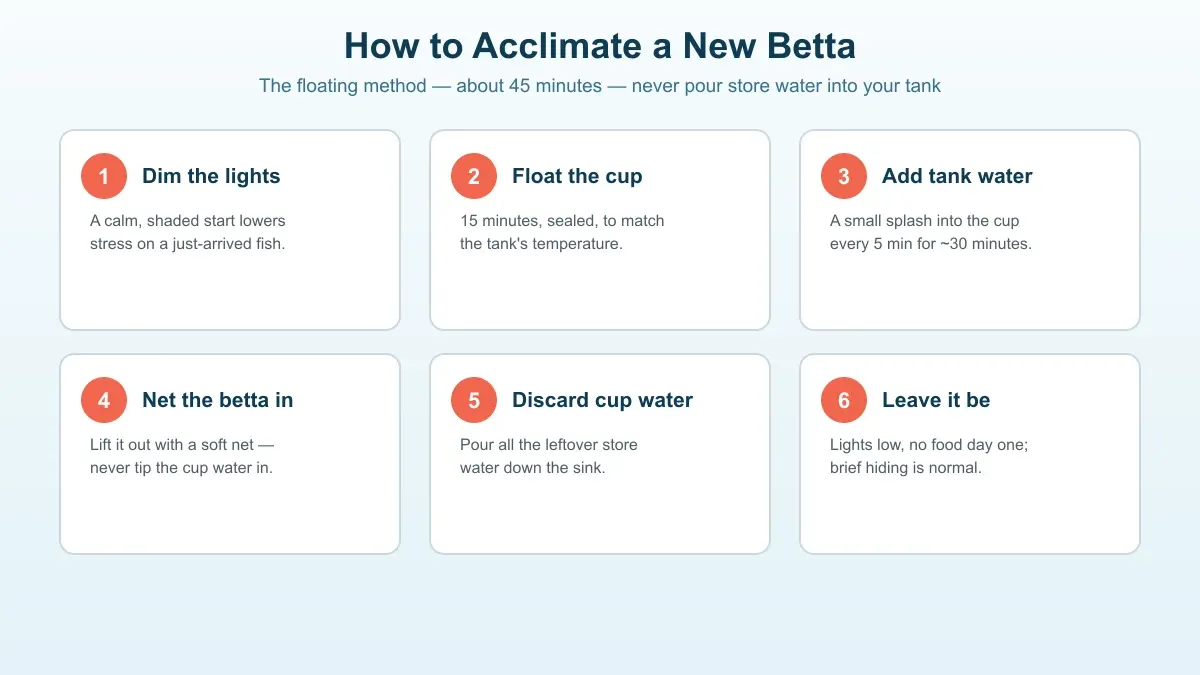
- 1 Turn off the tank lights and dim the room.
Bright light on a stressed, just-arrived fish makes everything worse. A calm, shaded start helps.
- 2 Float the sealed cup or bag on the tank surface for about 15 minutes.
Leave it closed for now. This lets the cup water slowly drift toward your tank’s temperature. If the temperatures are far apart, give it 20–30 minutes.
- 3 Open the cup and pour out a little of the travel water.
Down the sink, never into your tank. This makes room and starts removing the old store water.
- 4 Add a small splash of tank water to the cup every 5 minutes.
Roughly a quarter-cup (about 60 ml) each time. Keep the cup floating between additions. Do this for about 30 minutes, until the cup is mostly your tank’s water.
- 5 Net the betta out of the cup and lower the net into the tank.
Let it swim free. Use a soft aquarium net — don’t chase it around the cup, just guide it in calmly.
- 6 Pour all the leftover cup water down the sink.
None of it goes in your tank. (More on why below — this is the non-negotiable rule.)
That’s it. Turn the lights back on later, not immediately, and leave your new betta alone to explore.
Method B: Drip Acclimation (Slower, Gentler — Best Practice for Sensitive Cases)
Drip acclimation does the same job as the floating method but stretches the water-chemistry transition out over 1–2 hours, with new water trickling in drop by drop instead of in splashes. It’s the gentlest option and the one many experienced keepers consider best practice — especially when the chemistry gap is large. It needs one cheap extra item: a length of standard airline tubing.
- 1 Float the sealed cup for ~15 minutes first
to match temperature, exactly as in Method A, steps 1–2.
- 2 Move the betta and its water into a clean cup or small container
placed below the tank’s water level — on the floor or a low stool works.
- 3 Set up a siphon with airline tubing
from the tank down to the container. Tie a loose knot in the tubing (or use a cheap drip/control valve) to slow the flow.
- 4 Adjust the drip to about 1 drop every 1–2 seconds.
Tighten the knot if it runs too fast. You want a slow, steady trickle — not a stream.
- 5 Let it drip until the container has roughly doubled
(about 50% original water, 50% tank water). Pour off some water and let it double again if you want to be extra gentle. This usually takes 1–2 hours total.
- 6 Net the betta into the tank
and discard all the container water down the sink — same rule as before.
Which Method Should You Use?
For most people bringing home a pet-store betta into a cycled, well-matched tank, the floating method is all you need — it’s faster and the chemistry gap is usually small. Reach for the drip method when the change is bigger or the fish is more fragile.
When in doubt, drip acclimation is never the wrong choice — it’s just slower. There’s no betta that’s harmed by a gentler, more gradual introduction.
The One Rule You Can’t Break: Never Pour Store Water Into Your Tank
Both methods end the same way for a reason. Net the fish; discard the cup water. Store and shipping water can carry parasites, bacteria, ammonia, and medications you don’t want anywhere near your clean, cycled tank. You spent the whole acclimation getting your betta used to your water — there’s no reason to dump the old water in with it.
So the cup water always goes down the sink, and only the fish goes in the tank. If you’re nervous about netting, lower the net into the tank and let the betta swim out on its own rather than tipping it.
Common Acclimation Mistakes to Avoid
Most new-betta losses come down to a handful of avoidable slip-ups:
- Dumping the store water into the tank. The big one. Net the fish; bin the water.
- Rushing it. Two minutes of floating isn’t acclimation. Give temperature ~15 minutes and chemistry ~30 minutes minimum.
- Skipping the temperature match. Cup water is usually cooler than a heated tank. Float first, every time.
- Adding the fish to an un-cycled tank. Acclimation can’t save a betta from ammonia poisoning. Confirm 0 ppm ammonia and nitrite before the fish comes home.
- Bright lights on arrival. Lights off (or dim) for the first day lowers stress.
- Feeding immediately. A stressed, newly moved betta usually won’t eat, and uneaten food just fouls the water. Wait.
- Tapping the glass or hovering. Give the new fish space and quiet to settle in.
The First 24–48 Hours: What’s Normal
Once your betta is in the tank, the job shifts from doing to leaving alone. The first day or two is when a new betta is most stressed, so the goal is a calm, boring environment.
- Keep the lights low or off for the first day. A dim tank helps your betta settle without feeling exposed. Ease the lights back to a normal schedule after a day or so.
- Don’t feed on day one (or feed very lightly). It’s normal for a new betta to ignore food for the first few days — its appetite returns once it feels safe. Pellets that sit uneaten only hurt your water quality. If it still won’t eat after several days, work through our guide on a betta that’s not eating.
- Expect hiding and skittishness. A new betta often tucks behind plants, sits near the bottom, or darts away from movement. Plenty of plants or a cave make this easier. This is normal settling-in behavior.
- Watch color and fins as a read on stress. Slightly faded color and clamped fins for a day or two can be normal stress; bright color and relaxed, flowing fins mean your betta is comfortable.
A new betta hiding or not eating for a few days is normal and usually nothing to fix. What’s not normal is those signs dragging on. If your betta is still lethargic, refusing food, clamped, or hiding after about a week of correct acclimation, re-check your water parameters and temperature first — those cause the vast majority of problems.
When to consult an aquatic vet
If conditions are right and you see clear illness signs — white spots, sores, a swollen belly, or scales sticking out like a pinecone — consult an aquatic veterinarian. Finned Friends can help you understand the common causes, but we’re hobbyists and researchers, not a substitute for veterinary care.
FAQ
Q.How long should I acclimate a betta fish?
About 45 minutes for the floating method (15 minutes floating for temperature, then ~30 minutes adding tank water) and 1–2 hours for drip acclimation. If your tank and the cup are very close in temperature and pH, you can lean toward the shorter end; if they differ a lot, take longer.
Q.Can I just pour my betta into the new tank?
You shouldn’t. Pouring the fish straight in skips both the temperature and chemistry match, and it dumps store water into your clean tank. Even when the tank is perfect, that sudden double shock can stress or kill a betta within a day or two.
Q.Do I really need the drip method, or is floating enough?
Floating is enough for most store-bought bettas going into a well-matched, cycled tank. Use the drip method when the fish was shipped, when there’s a big water-chemistry difference, or whenever you simply want the gentlest possible transition.
Q.Why can't I add the cup or bag water to my tank?
Store and shipping water can carry parasites, bacteria, ammonia, and leftover medications. There’s no upside to adding it. Net the betta in and pour the old water down the sink.
Q.My new betta is hiding and won't eat — did I do something wrong?
Probably not. A few days of hiding and skipped meals is normal as a new betta settles in. Keep the lights low, leave it alone, and confirm your water is warm and clean. If it’s still happening after about a week, re-check your parameters and read our not-eating guide.
Q.Should the tank light be on during acclimation?
No — keep it off or dim during acclimation and for the first day. Bright light adds stress to an already-stressed fish. Return to a normal light schedule after the first day or so.
Sources & Further Reading
- Bettafish.org — How to Acclimate Betta Fish — step-by-step acclimation guidance.
- Aquarium Store Depot — How to Acclimate Betta Fish — floating and drip method walkthroughs.
Acclimation is the last step of bringing a betta home — the rest is good, stable care. For the full picture, start with our complete betta care guide, and make sure your tank setup is dialed in before the fish arrives. 🐠