That distinction is the spine of this guide. Nearly every article you’ll find lumps floating and sinking together and hands you the same fast-and-feed-a-pea protocol for both.
Direction narrows the field, though — it doesn’t hand you a diagnosis. One aquatic veterinary practice reports that in their goldfish caseload, only about 10% of buoyancy problems are primary swim bladder disease — the other 90% are water quality, diet, husbandry, or trauma. Bettas aren’t goldfish, but the lesson carries: test your water before you treat the bladder. Watch which way gravity takes your fish, then get a test kit out. In that order, and never skipping the second part.
In this guide
- 01 What the Swim Bladder Actually Does
- 02 Floating, Sinking, or Sideways? Start Here
- 03 The Floating Betta: Trapped Gas and Constipation
- 04 The Sinking Betta: When It’s More Than Feeding
- 05 The Sideways or Corkscrewing Betta
- 06 Is It Swim Bladder, or Something Else?
- 07 How to Treat It, Step by Step
- 08 Epsom Salt: What It Does and What It Doesn’t
- 09 The 7-Day Recovery Timeline
- 10 How to Prevent It
- 11 When to Get Help
- 12 FAQ
What the Swim Bladder Actually Does
The swim bladder is a gas-filled internal organ that works like a buoyancy vest. By adjusting the gas inside it, a fish holds any depth it wants without swimming — which is why a healthy betta can hang motionless mid-water, perfectly level, and look effortless doing it.
When that organ stops regulating properly, the fish loses neutral buoyancy. Everything else can still be fine: your betta may be alert, brightly colored, and hungry, yet physically unable to hold position. That combination — normal behavior, abnormal orientation — is what makes swim bladder trouble so distinctive and so alarming to watch.
“Swim bladder disorder” is a description, not a diagnosis. It’s shorthand for “this fish can’t hold its position,” and there are several very different reasons that happens. Trapped gas from a backed-up gut is one. Poor water quality — the one aquatic vets see most — is another. Infection, injury, and neurological damage are others. Same visible symptom, unrelated fixes.
Telling these apart properly needs imaging: vets use X-rays to distinguish a true swim bladder problem from a gassy digestive tract — exactly the call you’re making by eye at home. Run the triage below, but hold your conclusions loosely.
Floating, Sinking, or Sideways? Start Here
This is the fastest useful observation you can make, and it takes five seconds. Watch your betta for a minute without disturbing it and note where the water takes it when it stops swimming.
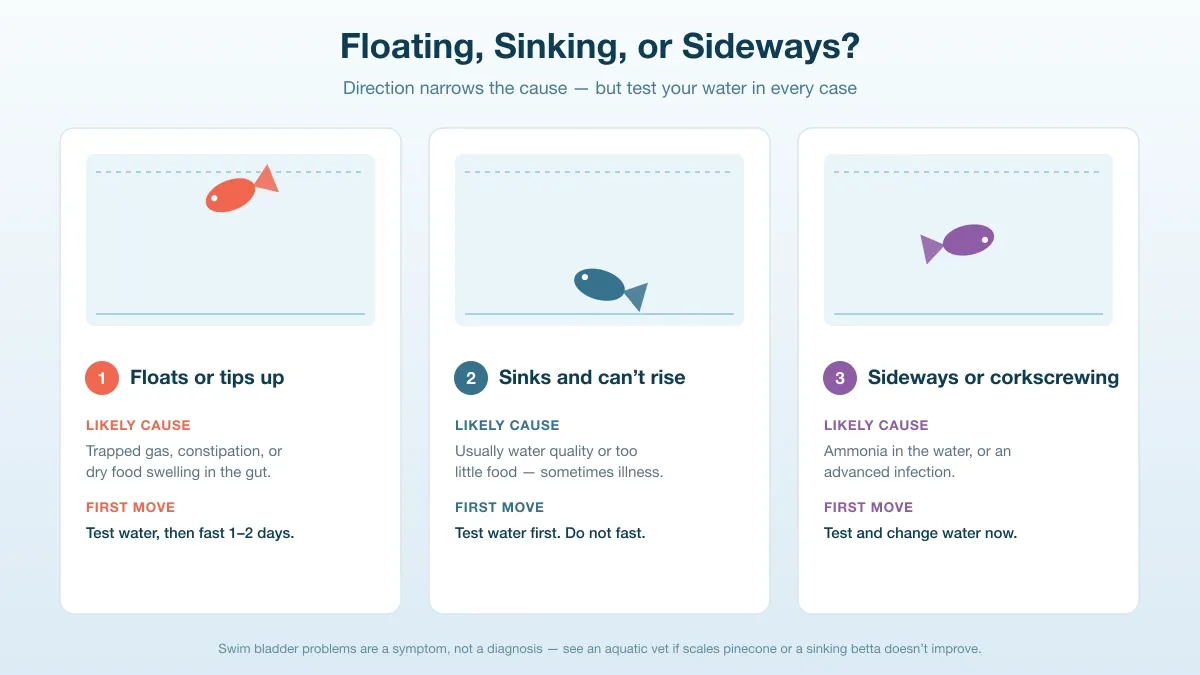
If you remember one line from this page: fasting often helps the floater and rarely helps the sinker. Test your water either way.
The Floating Betta: Trapped Gas and Constipation
If your betta is bobbing at the surface, tipping onto its side up top, or paddling hard just to get down and popping straight back up, you’re almost certainly looking at a digestive problem rather than a disease.
Three habits cause most of it:
- Overfeeding. The common rule of thumb is a pellet portion matched to the size of the betta’s eye — a practical guide to portion size, not a literal measure of the stomach. Beginners routinely feed several times that, and the surplus backs up.
- Dry pellets and freeze-dried food fed unsoaked. These foods are dehydrated, so swallowed dry they can keep absorbing water and expand inside the gut. Soaking them in tank water for a few minutes first is cheap insurance.
- Gas in the digestive tract. Gas trapped in a backed-up gut can press on the swim bladder from outside it. A betta’s labyrinth organ, which it uses to breathe air at the surface, is a separate structure from the swim bladder — normal surface-gulping is not filling the bladder with air.
The fix is the fasting-first protocol in our betta constipation guide: stop feeding for one to two days, keep the temperature stable, then reintroduce food gently. Skipping meals for a couple of days will not harm a healthy adult betta — a weekly fast is standard good care. Once it’s resolved, portion control is what keeps it from coming back, and how often to feed a betta fish covers the amounts.
The Sinking Betta: When It’s More Than Feeding
A betta that sinks and stays down usually isn’t suffering a swim bladder failure at all. True negative-buoyancy disorders in bettas are reported as rare; what looks like “sinking” is far more often plain lethargy — a fish that feels bad and stops holding itself up. Aquatic Veterinary Services notes that in their caseload, negative buoyancy is usually a fish lethargic from poor water quality or not eating enough, and their first instruction is to test your water, not to treat the bladder.
Causes worth working through, roughly in order of likelihood: poor water quality, underfeeding or an unsuitable diet, general illness, cold water, and less commonly physical injury, internal swelling crowding the bladder, or a congenital defect. Almost none are fixed by skipping meals — and if the fish was already underfed, fasting actively makes it worse.
One distinction matters here, because bottom-sitting is innocent more often than people expect. A betta that chooses to rest on the substrate and swims up alertly when you approach is usually just resting, sleeping, or aging — our guide on why a betta lies at the bottom of the tank covers that triage. This page is about the betta that can’t rise.
The Sideways or Corkscrewing Betta
A fish that rolls, spirals, or darts erratically without holding any orientation is showing something beyond simple buoyancy trouble. Test your water before you do anything else. Ammonia and nitrite should read 0 ppm on a liquid test kit; anything above that is actively poisoning your fish, and ammonia toxicity is a well-known cause of erratic, disoriented swimming.
If the water is off, a partial change with dechlorinated, temperature-matched water is the immediate move — see betta water changes for the correct volume and method. If the water tests clean and the corkscrewing continues, you’re likely looking at neurological damage or an advanced internal infection.
Of the three directions, corkscrew swimming has the poorest outlook. It can improve if water quality was the cause and you catch it early. If the damage is neurological, it often doesn’t.
Is It Swim Bladder, or Something Else?
Three conditions get mistaken for swim bladder disorder, and one of them is an emergency:
- Dropsy. Whole-body swelling with scales raised like a pinecone, most visible looking down from above. Dropsy isn’t a disease in its own right — it’s fluid building up in the body cavity, a sign of serious underlying illness, often kidney or liver trouble behind a bacterial infection. It needs a vet promptly. Fish caught early with a correct diagnosis sometimes recover, but the prognosis is guarded, because visible pineconing usually means the illness is already advanced.
- Plain constipation. A swollen belly with flat scales and a fish that’s still essentially upright. Treat the constipation and the buoyancy usually follows.
- Mycobacteriosis. Progressive wasting alongside a visibly curved spine. A chronic bacterial condition, not a swim bladder problem; antibiotics may slow it but generally won’t cure it. It also matters for you, not just the fish: fish mycobacteria are zoonotic and can infect people through cuts and scrapes. Wear waterproof gloves in the tank, and see a doctor about any skin lesion that won’t heal.
The full side-by-side comparison of constipation, dropsy, and swim bladder disorder lives in our betta constipation guide.
How to Treat It, Step by Step
- 1 Test the water
Ammonia and nitrite at 0 ppm, nitrate low. Bad water either causes the problem or makes recovery impossible, so this comes first regardless of direction.
- 2 Check the temperature
A stable 78–80°F. Cold water slows digestion, which makes a floating case worse and recovery slower.
- 3 Fast for 1–2 days, but only if your betta is floating
Skip this step entirely for a sinker; it doesn’t apply.
- 4 Reintroduce food, and consider daphnia
Daphnia is part of a betta’s natural diet, which already makes it a more species-appropriate first meal than the famous pea. Hobbyists widely credit its chitinous shell with a mild laxative effect; treat that as long-standing keeper practice rather than a proven clinical mechanism.
- 5 Lower the water level if your fish is struggling
A betta that has to fight to reach the surface for air is burning energy it doesn’t have. Dropping the water to a shallower level, keeping it warm and clean, makes each trip up much cheaper — one of the most effective supportive measures available, and it costs nothing.
- 6 Consider Epsom salt only if indicated
See the section below before you do.
- 7 Reassess at day 7
More on that in the timeline.
Best food for betta fish covers sourcing and portioning for step 4.
Epsom Salt: What It Does and What It Doesn’t
Epsom salt is magnesium sulfate — not aquarium salt and not table salt. The rationale keepers give for a short bath is osmotic: the solution is meant to draw excess fluid out of a swollen fish, relieving swelling and helping pass a blockage. This is long-standing hobbyist practice rather than a well-studied clinical treatment, and it does nothing for an infection. A supportive measure at best, never a cure.
The figures below are hobbyist practice, not veterinary dosing. The method most keeper guides describe is a separate container of dechlorinated, temperature-matched tank water with the Epsom salt fully dissolved before the fish goes in. Published hobbyist amounts run from 1 teaspoon to 1 tablespoon per gallon, for a short, supervised bath.
Duration is where sources contradict each other. Some widely read betta guides specify a five-to-eight-minute dip; other keeper guides and forums say ten to fifteen minutes, some twenty. No clinical standard exists to settle it — this is accumulated keeper practice, and the disagreement reflects that rather than one source being wrong. If you try it, start at the low end of both ranges (1 teaspoon per gallon, around five minutes) and watch the whole time. A weak, short bath that does little is a better error than a strong, long one on a fish that’s already unwell. For dosing matched to your fish, ask an aquatic veterinarian, who can also confirm the diagnosis.
When not to use Epsom salt:
- When it might be dropsy. Some keepers and vets use it as supportive care for the fluid buildup, but it doesn’t address the cause — treat pineconing as a reason to call a vet, not to reach for the salt tub and wait.
- Alongside aquarium salt. Don’t stack salt treatments. They’re different compounds doing different things, and combining them stresses the fish.
- On a sinking betta with no swelling. There’s nothing for it to draw out.
- As a routine additive. It’s an intervention, not maintenance.
- Never undissolved. Always dissolve fully in a separate container first — crystals directly on a fish can burn.
Always watch the fish for the entire bath and return it to clean tank water immediately if it shows distress.
The 7-Day Recovery Timeline
Days 1–2. Follow steps 1–5 above. Expect no visible change yet — that’s normal.
Days 3–5. Reintroduce a small amount of food, daphnia if you have it. A floating case often improves noticeably here: the fish holds depth longer, tips less, and produces normal droppings. A sinking case that hasn’t moved at all by day 5 is a strong signal you’re treating the wrong thing — go back to water quality and diet.
Day 7 — the decision point. Two honest outcomes:
- Improving: buoyancy is better even if not perfect. Continue small, soaked, portion-controlled meals and give it another week.
- No change or worse: stop treating it as constipation. Recheck water quality and temperature, then contact an aquatic vet. A week is long enough to show that fasting isn’t the answer here.
Seven days is a practical review point, not a clinical milestone — nobody has established a fixed recovery clock for betta buoyancy problems. It’s simply long enough that a mild dietary case should have shown movement, and short enough that you haven’t burned the window on something treatable.
Chronic but stable. Some bettas never fully recover and live for months or longer with permanent buoyancy trouble. They eat, they’re alert, they respond to you — they just list, or float, or rest low. That’s not a failure. With a shallow water level, easy surface access, gentle filter flow, a resting spot near the top like a broad silk leaf, and small soaked meals, a chronic-buoyancy betta can have a decent life. Judge it on whether the fish is eating, breathing comfortably, and engaged — not on whether it swims level.
How to Prevent It
- Portion control. Eye-size meals. When in doubt, feed less — our betta feeding calculator builds a portioned weekly plan with a weekly fast.
- Pre-soak dry food. A few minutes in tank water so pellets swell in the cup rather than in your fish.
- Run a weekly fasting day. One no-food day a week gives the gut a reset and is standard betta care.
- Hold 78–80°F. Stable warmth keeps digestion moving.
- Keep the water clean. Regular partial water changes prevent the ammonia spikes behind the worst cases.
When to Get Help
See an aquatic veterinarian if
Contact a qualified aquatic veterinarian if the scales are raised or pineconing; if a sinking betta hasn’t improved after correcting water, temperature, and diet; if there’s visible spinal curvature, wasting, or ulceration; if the corkscrewing continues after water quality has been confirmed clean; or if buoyancy trouble comes with refusing all food or labored breathing. Finned Friends can help you recognize and rule out the common, fixable causes, but we don’t diagnose disease — Maya Rivers is a hobbyist and researcher, not a veterinarian. When the picture points past feeding, a professional is the right call.
FAQ
Q.Is betta swim bladder fatal?
Not usually on its own. The floating, gas-and-constipation version is one of the most survivable problems a betta gets and often clears in a few days with fasting alone. What can be fatal is the underlying cause in a sinking or corkscrewing fish — untreated ammonia poisoning or a systemic infection kills, and the buoyancy trouble is only the visible symptom. That’s why the water test matters more than the label.
Q.Can betta swim bladder cure itself?
Often, yes — if it’s the floating kind and you remove the cause. Stop feeding, hold the temperature steady, and a mild constipation-driven case frequently resolves without any treatment beyond patience. What won’t self-correct is a case driven by infection, injury, or bad water. If nothing has changed after a few days of correct fasting and clean warm water, the problem isn’t one that fixes itself.
Q.How long does betta swim bladder last?
A mild floating case often improves within one to three days of fasting and frequently resolves inside a week, though there’s no fixed clock. Cases involving infection or injury run much longer and depend on treating the underlying cause. Use day 7 as a review point rather than a deadline: real improvement means keep going; no change means you’re probably treating the wrong thing, so recheck water quality and call a vet.
Q.Is it swim bladder or dropsy?
Look down at your betta from directly above. Swim bladder disorder affects position — floating, sinking, tilting — with scales lying flat. Dropsy causes whole-body swelling with scales raised like a pinecone: fluid accumulating because something serious is wrong internally, not a buoyancy fault. Dropsy needs prompt professional care; don’t fast it and wait. Our betta constipation guide has the full comparison table.
Q.Do peas actually work for swim bladder?
It’s debated. The pea remedy came out of goldfish keeping, and goldfish are omnivores — bettas are insectivores, and plenty of experienced keepers avoid peas for that reason. The usual justification, that pea fibre acts as roughage, is questioned by aquatic vets who note that fish don’t digest plant fibre the way we do. If you try a pea, use a tiny piece of a blanched, de-shelled one — never a large amount and never routinely.
Q.Should I lower the water level?
If your betta is visibly struggling to reach the surface, yes — it’s one of the most useful supportive steps available. Bettas breathe air, and a fish that can’t swim well burns precious energy on every trip up. A shallower tank makes each trip cheap. Reduce filter flow too, and add a broad silk leaf near the top to rest on.
Q.Can a betta live with permanent swim bladder damage?
Yes, and many do. A betta with lasting buoyancy trouble can live comfortably for months or longer once you adjust the tank around it — the timeline section above covers the specific accommodations. Judge quality of life by whether it’s eating, breathing easily, and responding to you, not by whether it swims level. Accepting chronic management is a legitimate outcome, not giving up.
Helpful sources: For the buoyancy-versus-lethargy distinction and the “test your water first” rule, see Aquatic Veterinary Services on swim bladder disease and their guide to a betta laying on the bottom of the tank, both of which stress that most buoyancy complaints trace back to water quality and husbandry rather than the organ itself. For the zoonotic risk noted above, see Texas A and M AgriLife Extension’s SRAC-4706, Mycobacterial Infections of Fish.
Direction first, treatment second — but water test always. Float means fast; sink means investigate; sideways means test your water immediately. For everything else your betta needs, start with our complete betta fish care guide. 🐠