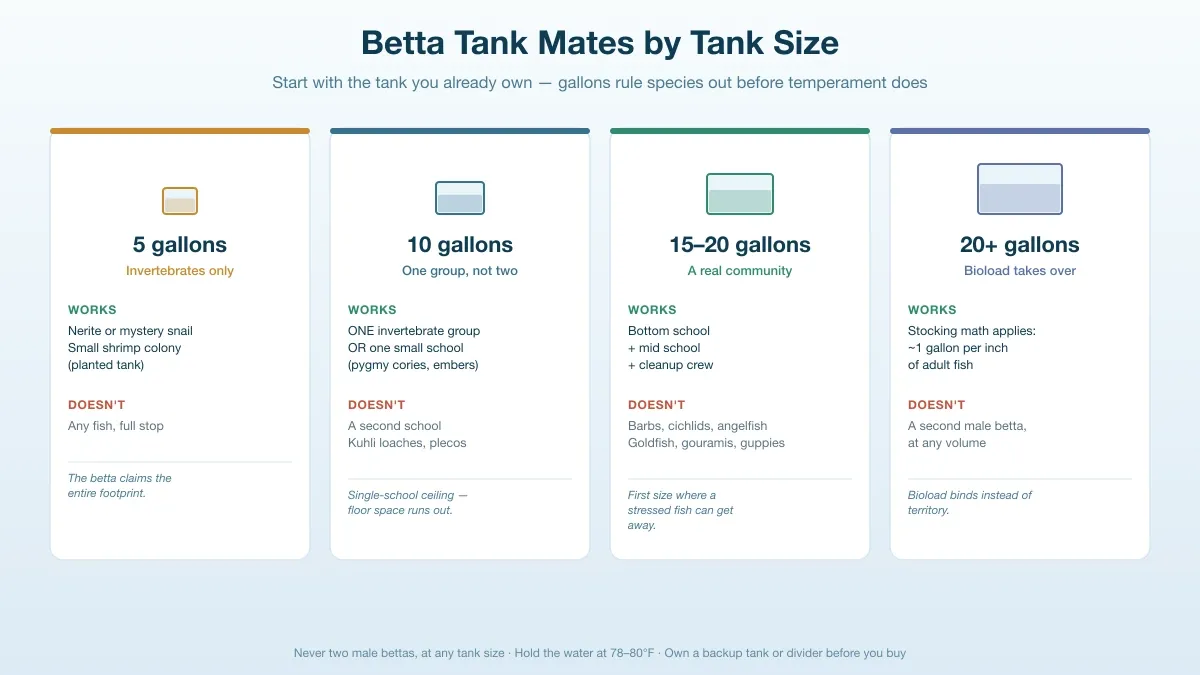
You already own the tank. Start there. Find your volume in the chart below and read across — and if you’re not sure how many gallons it is, our aquarium volume calculator works it out from the dimensions.
In this guide
- 01 Start With Your Tank Size, Not a Species List
- 02 The 5-Gallon Reality: Snails and Shrimp Only
- 03 What Makes a Good Betta Tank Mate
- 04 Tank Mates That Work, by Water Level
- 05 Tank Mates to Avoid
- 06 Can Two Bettas Live Together?
- 07 Do Bettas Get Lonely?
- 08 Before You Buy: the Backup Plan
- 09 How to Introduce a Tank Mate: the 72-Hour Trial
- 10 If It Goes Wrong
- 11 FAQ
Start With Your Tank Size, Not a Species List
Why sources say 10, 15, 20, or even 27 gallons
Search this topic for an hour and you’ll collect four different minimums from four reputable places. They aren’t contradicting each other so much as answering different questions, and once you see the three methods the disagreement mostly dissolves.
Per-species minimums. Retailer care guides set the floor from the tank mate’s requirements. Ember tetras want 10 gallons for a school, so betta plus embers reads as 10 gallons. Kuhli loaches want 20, so betta plus kuhlis reads as 20. It’s an honest method, and it’s why you see a spread of numbers rather than one.
Per-territory minimums. Some sources argue that under roughly 15 gallons a betta simply claims the whole tank, whatever the stocking chart says, and that anything sharing that space lives inside a defended territory rather than beside one. This method produces the highest floors and gives the most weight to the mate’s quality of life.
Per-bioload minimums. The classic one gallon per inch of adult fish. Work a modest community through it (a betta, a school of six, a few cleanup animals) and you can land near 27 gallons quite legitimately. It explains where the largest numbers come from. This method ignores behaviour entirely and only counts waste.
All three are defensible. The practical read: 10 gallons is the floor for adding any fish at all, and 15 to 20 is where things stop being a compromise. For the tank specs behind those numbers (heater wattage, filter flow, footprint in inches), our betta tank setup guide covers the hardware side.
The 5-Gallon Reality: Snails and Shrimp Only
A 5-gallon is a betta’s tank, not a community tank. That’s the same line our tank setup guide draws, and it’s where essentially every serious source lands. No fish. Not one small one, not a “just a couple” of anything.
There’s one exception, and it needs framing carefully: invertebrates are cleanup crew, not company. A nerite snail grazing algae off the glass isn’t sharing the betta’s world in any meaningful sense. It occupies a niche the betta doesn’t want and makes almost no claim on the territory.
Nerite snails are the safest single addition. They’re peaceful and they genuinely work through algae. Their larvae need brackish or salt water to develop, so the eggs a female lays in a freshwater tank won’t hatch. You’ll never wake up to a population explosion. Worth knowing before you buy, though — she will still lay them, as hard white specks on glass and hardscape that are stubborn to scrape off. It’s cosmetic. Mystery snails also work and have more personality, though they’re bigger and add noticeably more waste to a small tank.
Shrimp are the honest coin flip. Cherry shrimp and ghost shrimp are the usual candidates, and this is the one recommendation on this page where reputable sources genuinely disagree: some betta guides class small shrimp as unsafe outright, while shrimp specialists say it usually works out. The realistic picture, in the words of one shrimp retailer, is that most bettas will pick off the occasional shrimp fry and leave it at that, some ignore shrimp entirely, and others will cause carnage, and there’s no way to know in advance which one you own. Bettas are carnivores that eat small invertebrates in the wild, so a betta hunting shrimp isn’t misbehaving; it’s being a betta.
Two things improve your odds: heavy planting with real cover (moss, floating plants, driftwood), and starting with a colony rather than two or three individuals, since cherry shrimp breed fast enough that a colony can usually absorb losses a handful of individuals could not. Adult cherries are also a little large for a betta to swallow easily, which helps. Amano shrimp are bigger again and often left alone for that reason, though “often” is not “always” — a betta may still harass their antennae. Go in expecting to lose some, or don’t go in.
Do not add invertebrates to a brand-new tank. Wait until the tank has been stable for a few weeks and the betta has settled.
What Makes a Good Betta Tank Mate
Three traits do most of the work, and each has a reason behind it.
Short fins. A betta reads long, flowing fins as another betta. Trailing finnage on a tank mate is close to an invitation, and it’s slow, which makes the mate easy to catch when the betta decides to test it.
Muted colouring. Bright red and iridescent blue are the colours bettas display at each other. A dull, silvery, or subtly coloured fish reads as scenery. This is why an olive-brown cory sails through and a flashy guppy often doesn’t.
A different water level. Bettas own the top third of the tank. They surface to breathe through their labyrinth organ and they rest near the top. A fish that lives on the sand or cruises the middle rarely enters the space the betta is defending. Surface-dwellers put themselves in the one place they shouldn’t be.
Speed is the useful fourth trait. A fish that can outrun a betta is a fish that survives a bad afternoon.
None of this is deterministic. Individual temperament is real, and some bettas will not tolerate anything at all regardless of how well the species checks out on paper. Choose against these rules and you’re gambling; choose with them and you’re merely taking a normal risk.
Tank Mates That Work, by Water Level
Group sizes below are the figures commonly recommended in hobby care guides. Schooling fish kept below their minimum don’t just look worse — they hide, they colour down, and they’re more prone to illness.
Bottom of the tank
Pygmy corydoras (Corydoras pygmaeus) are the best first tank mate for a 10-gallon. They’re tiny, peaceful, and shoal happily. Six is the figure most commonly quoted as a bare minimum, but Aquarium Co-Op goes further and recommends a group of 8 to 12 in a 10-gallon or larger, on the grounds that a bigger shoal is markedly less shy and actually comes out where you can see it. Treat 6 as the floor and 8-plus as the target. They need fine sand rather than sharp gravel, since coarse substrate damages their barbels. On temperature, apply the same test we applied to panda cories below: Aquarium Co-Op says pygmies “appreciate slightly cooler temperatures between 72–78°F,” and other care guides stretch the top end only to about 79°F. That sits just under our 80°F ceiling, so run a betta-and-pygmy tank at 78–79°F — the bottom of the betta’s band — rather than at 80. Get the setpoint right and the fish is fine. One quirk worth knowing: unlike most cories, pygmies spend a fair amount of time mid-water rather than strictly on the bottom.
Larger cories need 20 gallons and up and a group of six or more. Which species you pick matters here, and temperature is the reason.
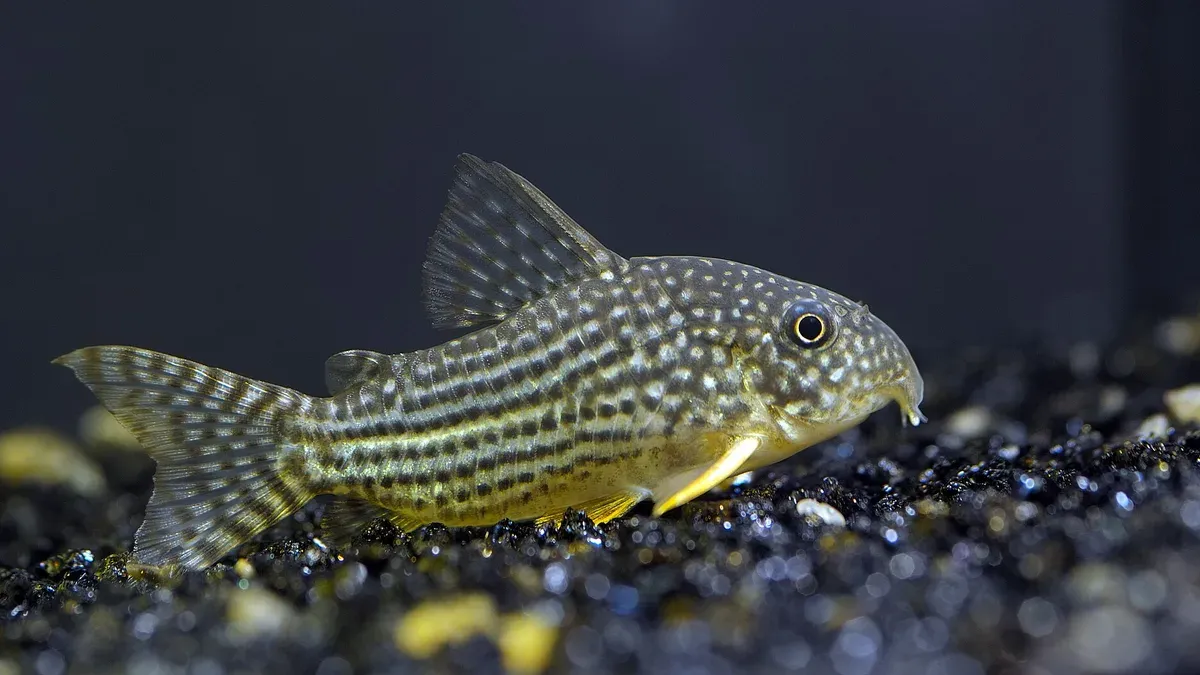
Sterbai corydoras are the one to pick. They sit comfortably at roughly 75–82°F, which overlaps a betta’s 78–80°F cleanly. Among the common cories they’re the warm-water specialist.
Panda corydoras are the one to think twice about. They’re widely described as preferring cooler water, broadly 68–77°F, which puts a betta’s 78–80°F at or just past the top of their range. Plenty of keepers report pandas doing fine around 77–78°F, so this isn’t a hard incompatibility the way goldfish are, but it is a permanent compromise in the panda’s direction, and you’d be running your betta at the bottom of its band to soften it. If you want cories in a betta tank and the tank is big enough, sterbai are the better-matched fish.
Kuhli loaches are wonderful and frequently recommended too early. Sources split here: a few put them as low as 15 gallons with a group of three. The more common and more defensible figure is a 20-gallon long minimum with at least 5 to 6 kept together, and we’ve taken the conservative read. Their long footprint matters more than tank height. They’re nocturnal and they burrow, so sand is non-negotiable.
Middle of the tank
Ember tetras are small, warm-toned, and stay comfortably out of the betta’s zone. Group guidance runs 6 to 10, with the larger end recommended for confident behaviour and better colour. On tank size, we use 10 gallons: a 5-gallon is the betta’s tank, and the school is the thing that doesn’t fit. Aquarium Co-Op does rate embers as small enough for a 5-gallon nano, but that’s the species kept on its own, without a territorial betta already holding the water. Their temperature range (roughly 72–82°F) comfortably includes 78–80°F.
Harlequin rasboras are hardier and slightly larger, and quick enough that most bettas give up chasing them. Group guidance is at least 8, with twelve or more considered ideal; at six or fewer the schooling behaviour breaks down and the fish turn shy and reclusive. On tank size, 10 gallons is quoted as a bare minimum for the species kept on its own, but guides covering them specifically as betta tank mates put the floor at 15 gallons, which is where our 15 to 20 gallon recommendation comes from. A school of eight-plus and a territorial betta are two different demands on the same water, and 10 gallons only satisfies one of them.
Neon tetras come up constantly and we’d steer beginners away. Published ranges vary, but neons are generally given a cooler band than a betta’s 78–80°F, and the comfortable overlap between the two species is narrow, often cited as only a couple of degrees. They’re also a nippy species when kept below their group minimum, and the red stripe is exactly the signal you’re trying to avoid. It’s not that the pairing never works; it’s that you’re managing a compromise from day one when better-matched options exist.
Cleanup crew
Nerite snails, mystery snails, amano shrimp, and cherry shrimp, as covered above. These scale to any tank size from 5 gallons up and are usually added last.
Hold them to the same temperature test as the fish. The snails clear it comfortably — nerites are usually given roughly 72–78°F with a much wider tolerance either side, and mystery snails a broad 65–82°F, so neither is troubled anywhere in a betta’s 78–80°F. Cherry shrimp are the one to watch. They’re commonly kept around 70–78°F, and sustained warmth is a known lifespan issue for them: shrimp keepers report that dwarf shrimp start to struggle above 80°F, and The Shrimp Farm’s own advice for housing them with a betta is to aim at “the Betta’s lower range,” suggesting 75–80°F. So if you’re keeping cherry shrimp, run the tank at 78°F rather than 80°F. That’s still squarely inside the betta’s range and it costs the betta nothing.
Tank Mates to Avoid
Goldfish. The mismatch here is thermal, and it’s the cleanest disqualification on the list. Goldfish are coldwater fish, generally given an ideal band of around 65–72°F; a betta needs a steady 78–80°F. The two bands don’t meet, so there is no thermostat setting that serves both. Held at betta temperature, a goldfish’s metabolism runs faster, it eats and excretes considerably more, and ammonia concentrates faster in the tank, and the problem compounds.
Fancy guppies. Long flowing fins in bright red and blue: from a betta’s point of view, the signature of a rival betta. Fancy-tailed males are the ones that get attacked; females are duller and shorter-finned, which makes them a somewhat safer bet without making them a good one.
Gouramis. Close relatives of the betta. Both are anabantoids, both breathe air at the surface through a labyrinth organ, both are territorial. The similar body shape and finnage read as a rival in both directions, so the aggression isn’t one-way. Dwarf gouramis are the worst offender, but the caution covers labyrinth fish generally.
Tiger barbs. Well-documented fin-nippers that shred long finnage. Keeping them in a large enough school reduces nipping generally, because they redirect it into their own pecking order, but that fix doesn’t extend to long-finned tank mates, and a betta cannot outswim them.
Angelfish and cichlids. Angelfish and bettas have a documented history of fighting, plausibly because of the similar tall, trailing-finned silhouette. Most cichlids are simply too large and too territorial, and both groups want tanks well beyond community-betta scale.
Any second male betta. See below.
Can Two Bettas Live Together?
This question deserves a direct answer, so here it is.
Two males: never. Not in any tank size, not with heavy planting, not with sight lines broken up. Male Betta splendens fight on contact and the fights are frequently fatal. A divided tank is a workable temporary holding arrangement (quarantine, a treatment period, a few days between homes), but it isn’t cohabitation, and as a permanent plan it means two fish spending their lives beside a wall they’d fight through if it failed. Two tanks are the honest version of the same setup, and neither fish spends its life beside a wall.
A male and a female: supervised breeding only. Housing them together is a breeding procedure with a defined start and end, run by someone who has a separate tank ready and knows the signs to pull the pair apart. It is not a way to keep a pair. Left together indefinitely, the pairing goes badly, usually for the female. Our male vs female betta guide covers the behavioural differences in more detail.
Sororities (groups of females): advanced, contested, and not a beginner project. They exist and some experienced keepers run them successfully. But the practice is genuinely disputed among serious hobbyists, with a common view being that even a stable sorority tends to break down eventually, and reported failure rates are high enough that a number of experienced keepers argue against attempting one at all. Females are territorial too; “less aggressive than males” is a comparison, and it only tells you they’re less aggressive than males. It needs a large heavily planted tank, a group big enough to spread aggression, close daily observation, and separate tanks ready for the fish you remove. If this is your first betta, it’s not your project.
Do Bettas Get Lonely?
No. Bettas are territorial, largely solitary fish. In the wild a male holds and patrols a small patch of water, usually given as a couple of square feet, and drives off rivals that enter it, with the sexes coming together to spawn rather than to live alongside each other. They are not a schooling species, and there’s no evidence they experience anything like loneliness. A betta alone in a well-planted, correctly heated tank is living the way the species lives.
Add tank mates because you want a more interesting tank and have the gallons to support one. Don’t add them out of guilt.
If your betta seems flat or withdrawn, the answer is almost never company. Our happy or stressed guide walks through what to check instead.
Before You Buy: the Backup Plan
Don’t buy a tank mate until you already own the place the loser will go.
That means a cycled backup tank, or at minimum a divider fitted and ready, purchased before the new fish comes home. Not researched, not bookmarked — owned, set up, and in the case of a backup tank, cycled.
The reason is timing. When an introduction fails, it fails within hours. If your plan at that moment is to drive to a store, the fish being chased has to survive the round trip. The failure mode is always the same: something goes wrong at 9pm and there’s nowhere to put anyone.
A store’s “we’ll take it back” policy is not a backup plan. Stores are shut at 11pm.
How to Introduce a Tank Mate: the 72-Hour Trial
- 1 Rearrange the decor first
Move the hardscape, plants, and cave a day before the new fish arrives. This breaks up the territorial map the betta has built and puts both fish on roughly equal footing.
- 2 Add hiding spots before you add the fish
A community tank needs more cover than a single-betta tank. Aim for several places where a fish can be fully out of sight, plus broken sight lines across the tank so the betta can’t survey everything from one spot.
- 3 Introduce the mate, and add schooling fish as a full group at once
Six cories going in together is a very different event from six cories going in one at a time.
- 4 Watch the first hour
Some flaring and investigation is expected. What you’re watching for is sustained pursuit — the betta following a specific fish across the length of the tank repeatedly. For reading the display itself, our betta flaring guide explains what each posture means.
- 5 Observe for 72 hours
Check several times a day, and specifically at feeding time, which is when trouble surfaces first.
- 6 Make the call at 72 hours
Not “keep monitoring”. A decision.
Abort criteria: watch the mate, not the betta
The mate is the one at risk, so these are the observations that matter:
- The mate hasn’t eaten. Food goes in and it doesn’t come out to feed, or gets driven off before it reaches any. This is the earliest reliable signal.
- The mate stays hidden constantly. First-day hiding is normal acclimation. Still hidden on day three, emerging only when the light is off, is not. This is the mirror image of the situation our betta hiding guide covers: same behaviour, different fish.
- The mate’s fins are clamped. Held tight against the body instead of spread.
- Torn, split, or shredded fins. Physical damage means remove today; don’t wait out the 72 hours.
- A shrimp colony that’s visibly shrinking. Count them.
Any of these means the trial has failed. If the betta is the one looking rough, work through our stress checklist instead — that’s a different problem with a different fix.
If It Goes Wrong
Move the mate, not the betta. The betta’s territory is established and moving it just resets a problem you’d have to solve again.
Then work out which of three things happened: wrong species, wrong tank, or an individual betta that won’t accept company. The third is commoner than it gets credit for, and it isn’t a failure on your part. Some bettas are single-occupancy fish for life, and a beautifully planted 5-gallon with one contented betta in it is a complete, successful aquarium.
FAQ
Q.Can two bettas live together?
Two males, never: they fight on contact and the fights are often fatal, regardless of tank size or planting. A divider works as a short-term holding measure but isn’t a fair permanent arrangement. A male and female should only share water under supervision for breeding, with separate tanks ready. Sororities of females are an advanced, genuinely contested practice with high reported failure rates; they aren’t a beginner project. If you want two bettas, the honest answer is two tanks.
Q.What can go in a 5-gallon tank with a betta?
Invertebrates only. A nerite snail is the safest choice: peaceful, effective on algae, and its eggs won’t hatch in freshwater because the larvae need brackish water to develop, though she’ll still lay hard white specks you’ll have to scrape off. A mystery snail also works but adds more waste. A cherry or ghost shrimp colony is possible in a well-planted 5-gallon, with the caveat that some bettas hunt shrimp and others ignore them entirely. No fish belong in a 5-gallon with a betta. Think of inverts as cleanup crew rather than company.
Q.Can bettas live with guppies?
It’s one of the worse pairings you can choose. Fancy male guppies have long flowing fins in bright red and blue, precisely the signals a betta uses to identify a rival, so many bettas attack them on sight. Guppies also occupy the upper water column, putting them in the betta’s territory rather than beside it. Female guppies are duller and shorter-finned, so they’re a slightly better bet in 15-plus gallons, but there are far safer options.
Q.Will my betta kill neon tetras?
It might, and even where it doesn’t, the pairing has other problems. Neons are generally given a cooler range than a betta’s 78–80°F, and the comfortable overlap between the two is narrow, so you’re likely running at least one of them at the edge of its band rather than in the middle of it. They’re also known nippers when kept in groups below their minimum, which puts a betta’s long fins at risk from the other direction. If you want a small mid-water school, ember tetras or harlequin rasboras are better matched on both temperature and behaviour.
Q.Do betta fish need company?
No. Bettas are solitary and territorial by nature, defending a patch of water and driving off intruders. A single betta in a heated, planted, properly sized tank is behaving normally. Loneliness is something we project onto them. Add tank mates because you want a more varied aquarium and have the gallons for it, never out of guilt on the fish’s behalf. If your betta seems withdrawn, check water parameters and temperature first.
Q.Can bettas live with shrimp?
Sometimes, and it depends on the individual betta. Some betta guides call small shrimp unsafe outright; shrimp specialists report that it usually works. The common ground is that most bettas take the occasional shrimp or shrimplet and otherwise coexist, a few ignore shrimp entirely, and a few clear the tank out, and you can’t tell which you have until you try. Improve your odds by planting heavily, starting with a colony rather than a handful, and choosing larger shrimp — amanos are often too big for a betta to bother with. Count them weekly.
Q.How many gallons do I need for a betta community?
Ten gallons is the floor for adding any fish at all, and it supports exactly one small school or one invertebrate group. A real community (a bottom school, a mid school, and a cleanup crew) wants 15 to 20 gallons, because that’s the first size where a harassed fish can genuinely get away. Above 20 gallons, standard stocking math takes over and bioload rather than territory becomes your limit.
Q.What do I do if my betta attacks a tank mate?
Remove the tank mate, not the betta. The betta’s territory is established and relocating it just recreates the problem. This is why the backup tank or divider needs to be ready before you buy anything. Once everyone is safe, work out which of three things went wrong: the wrong species (long fins, bright colours, surface-dwelling), the wrong tank (too few gallons for a community), or an individual betta that won’t accept company. All three are common, and the third is nobody’s fault.
Helpful sources: For pygmy corydoras group and tank minimums, including the recommendation of 8 to 12 in a 10-gallon or larger and their 72–78°F temperature band, see Aquarium Co-Op’s care guide for pygmy corydoras; for ember tetra group sizes and their 72–82°F range, their ember tetra care guide. Harlequin rasbora schooling behaviour (groups of eight or more, breaking down at six or fewer) is covered in AquariumStoreDepot’s harlequin rasbora care guide, and their broader betta tank mates guide is where the 15-gallon floor for rasboras alongside a betta comes from. For kuhli loach footprint and group minimums see The Shrimp Farm’s kuhli loach care guide; for the honestly mixed real-world record of keeping shrimp with a betta, plus their advice to hold the tank at “the Betta’s lower range” so the shrimp aren’t cooked, their write-up on cherry shrimp and bettas. The coldwater band goldfish need, and why warmer water compounds their waste problem, is set out in AquariumStoreDepot’s goldfish temperature guide. For the contested state of betta sororities, AquariumStoreDepot’s sorority overview lays out the case on both sides; its own summary is that sororities “fail more often than they succeed.”
Start with your gallons, not a wishlist. Five gallons means snails or shrimp and nothing else; ten gallons buys you one small school; fifteen to twenty is where a community stops being a compromise. Buy the backup tank before you buy the fish, then give it seventy-two hours and make an honest call. For everything else your betta needs, our complete betta fish care guide is the place to start. 🐠