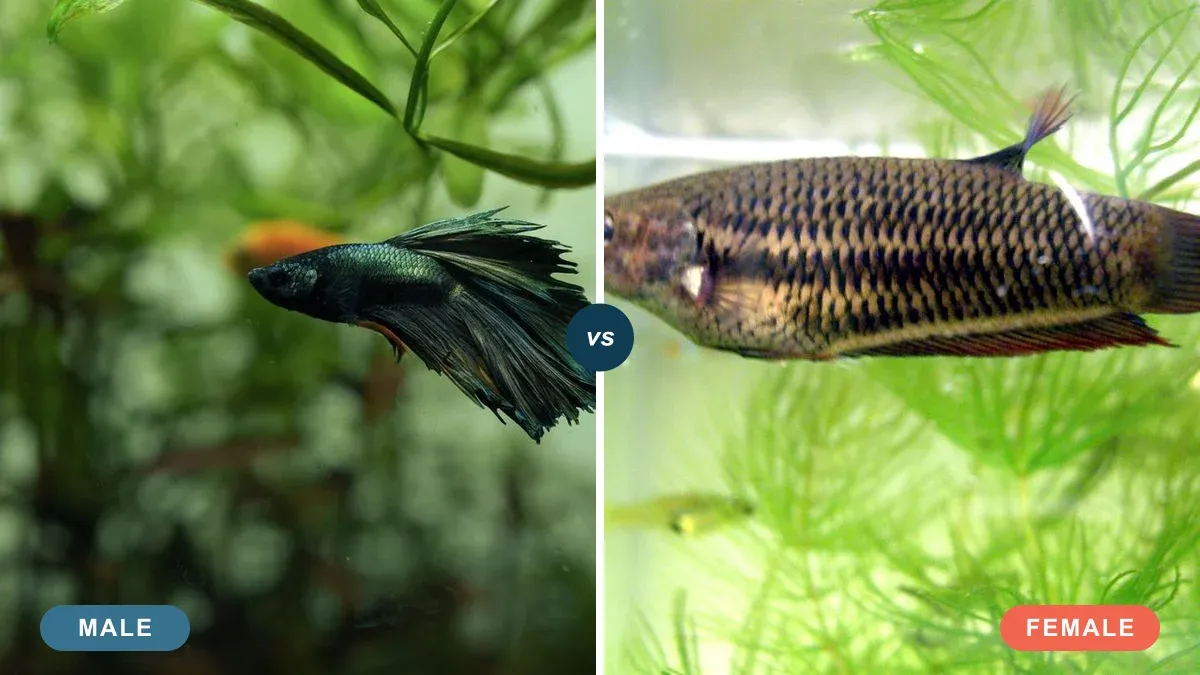

If you’re standing in front of a tank trying to work out which betta you’ve got — or which to bring home — this guide gives you a side-by-side table, a trait-by-trait breakdown, the signs that actually hold up (and the one that doesn’t), and the truth about housing them together.
In this guide
Quick Answer: The Fastest Way to Tell
Look at three things, in this order of reliability:
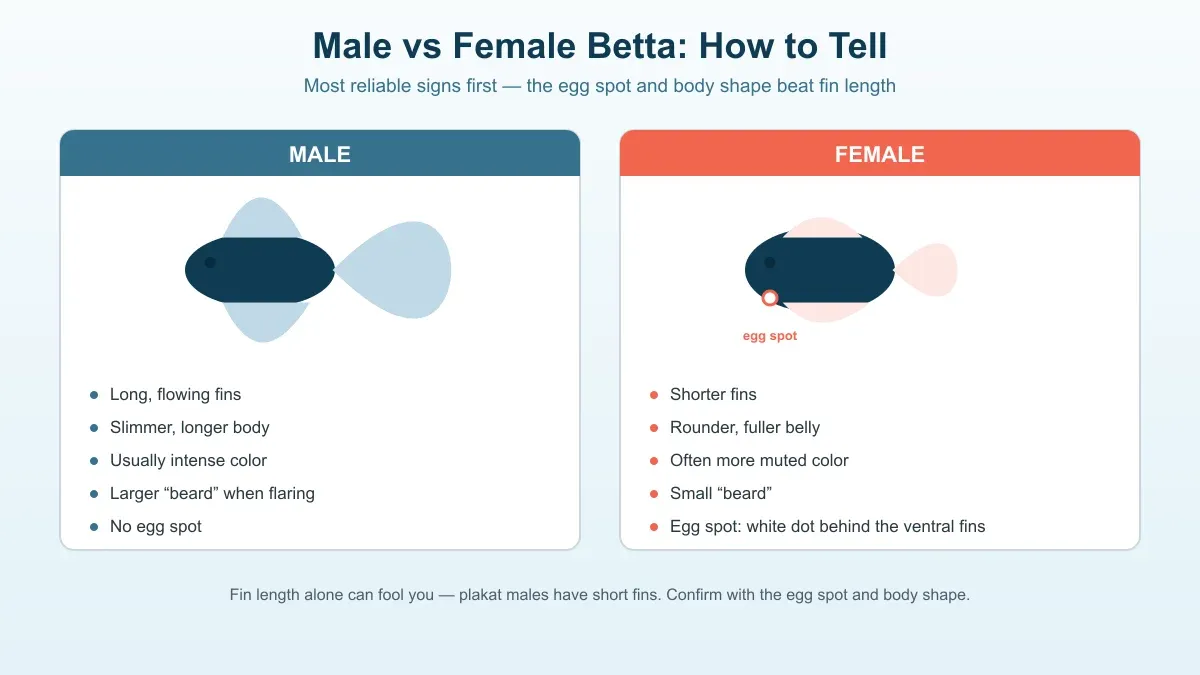
- The egg spot. A small white dot on the belly, just behind the ventral fins and in front of the anal fin, means female. Males rarely show a true one. This is your most trustworthy single sign.
- The body shape. Females tend to look shorter and rounder, especially through the belly. Males look longer and slimmer side-on.
- The fins. Long, dramatic fins usually mean male — but short-finned “plakat” males exist, so don’t rely on fins by themselves.
Color and aggression are weak clues. Both can point you in the right direction, but neither is dependable on its own. A drab male and a vivid female are both completely normal.
Male vs Female Betta: Side-by-Side Comparison
Here’s the full picture in one place. Treat the top rows as the reliable signals and the bottom rows as supporting hints, not proof.
Trait by Trait: What Each Sign Really Tells You
Fins
This is the difference everyone reaches for first, and it’s a fair starting point: a classic male betta has long, trailing fins, while a female’s are short and neat. The catch is the plakat — a short-finned type of male that’s increasingly common in stores. A plakat male can have fins barely longer than a female’s, which is exactly why so many get mislabeled and sold as females. So use fin length as a hint, never as your final answer.
Body shape and size
Side-on, females tend to look shorter and rounder, especially through the belly where they carry eggs. Males look longer and slimmer. The difference is subtle and easier to judge once you’ve seen a few bettas, but it’s a useful supporting clue — particularly with short-finned fish where the fins won’t help you.
Color intensity
Males often carry more saturated, showy color, and that’s part of why they dominate pet-store shelves. But color is genuinely unreliable for sexing. Females come in every color males do, and selective breeding has produced plenty of intensely colored females and comparatively plain males. Enjoy the color — just don’t use it to decide.
The egg spot and ovipositor
This is the one that holds up. A mature female develops a small white or pale-yellow dot — the ovipositor, often called the egg spot — on her underside, just behind the ventral fins and in front of the anal fin. It’s where eggs pass through during spawning. If you can clearly see it, you almost certainly have a female.
Three cautions. First, very young bettas may not show an egg spot yet, so its absence doesn’t prove “male.” Second, on rare occasions a stray reflective speck gets mistaken for one — look for a defined, consistent dot in the right spot, not a fleeting glint. Third, a few males show a false egg spot that usually fades as they mature, while a true female’s ovipositor stays put — so weigh the egg spot alongside the other signs, not entirely on its own.
The beard (branchiostegal membrane)
Under a betta’s gill covers sits a membrane sometimes called the “beard.” On males it’s large and often peeks out even when the fish is calm; when a male flares, it puffs into a dramatic dark collar around the chin. Females have one too, but it’s much smaller and usually invisible unless she’s actively flaring. A prominent beard at rest is a strong male signal — and a handy tiebreaker for short-finned fish.
Flaring and aggression
Males are famously territorial and will flare at rivals, their own reflection, or anything that looks like competition. It’s tempting to treat “flares a lot” as “male,” but females flare and show aggression too — they’re simply, on average, less intense about it. Behavior is a weak clue at best. A flaring betta tells you the fish feels challenged, not necessarily that it’s male. (If you want to understand what flaring actually means, see our guide on betta flaring.)
How to Sex a Young Betta (the Most Reliable Method)
Sexing juveniles is harder because the traits people lean on — long fins, big beard, bold color — haven’t fully developed. Here’s the approach that actually works, in order:
- 1 Look for the egg spot first
Once a female matures enough, that small white ovipositor dot behind the ventral fins is the clearest tell. If it’s there, she’s female. If it’s not there, keep checking the other signs — young fish may simply be too immature to show it.
- 2 Check the ventral fins
Males usually have noticeably longer, fuller ventral fins (the long pair under the chin); females’ tend to be shorter and thinner. This often separates the sexes before other traits arrive.
- 3 Watch for the beard at rest
A membrane visible under the gills even when the fish is calm leans male.
- 4 Don't trust fin length on a plakat
A short-finned fish with an egg spot is female; a short-finned fish with a big beard, long ventrals, and no egg spot is very likely a plakat male. This is the trap that catches the most beginners.
The honest takeaway: with a very young betta, you sometimes can’t be 100% certain, and that’s normal. Give it time, watch for the egg spot and a developing beard, and the picture usually clears up as the fish matures.
Can Male and Female Bettas Live Together?
Short version: no, not as roommates. This is the part of “male vs female” that matters most for your fish’s safety, and it’s where casual advice does the most harm.
- Two males together: never. Male bettas are called Siamese fighting fish for a reason. Put two in one tank and they will fight, often to the death. There is no tank size, no amount of plants, and no “they seem fine so far” that makes this safe. The Betta splendens species profile on Seriously Fish notes that in most cases only a single individual can be kept per tank — this is the baseline rule of betta keeping.
- One male + one female: only for supervised breeding. Pairing a male and female is something experienced keepers do temporarily, under close watch, in a dedicated breeding setup — then they separate the fish. A male and female left together permanently is a recipe for chasing, torn fins, stress, and injury. It is not a beginner setup.
- Multiple females (a “sorority”): advanced and risky. Keeping a group of females together can sometimes work, but it’s not the gentle alternative it’s often made out to be. Females are territorial too, sororities need a larger heavily-planted tank, lots of sightline breaks, careful stocking, and constant monitoring — and they can still collapse into bullying. Treat it as an advanced project, not a starter tank.
For a single betta — male or female — the safe default is one betta, alone, in a properly heated, filtered, cycled tank. If you want company in the tank, the right move is researching compatible non-betta tank mates rather than adding another betta. For the full setup, start with our complete betta care guide.
A quick note on who I am
I’m a hobbyist and researcher, not a veterinarian. This guide is about telling the sexes apart and housing bettas safely — if your fish shows signs of injury or illness, an aquatic vet is the right call.
FAQ
Q.What's the single most reliable way to tell a male from a female betta?
The egg spot. A mature female shows a small white dot — the ovipositor — on her underside, just behind the ventral fins and in front of the anal fin. Males rarely show a true one (a few display a “false” spot that fades with age), so it beats fins, color, and behavior for reliability — just confirm it alongside the other signs.
Q.My betta has short fins. Is it female?
Not necessarily. Short-finned plakat males are common and routinely mistaken for females. Check for an egg spot (female), and for a large beard and long ventral fins (male). Don’t decide on fin length alone.
Q.Do female bettas flare?
Yes. Females flare and can be territorial and aggressive — usually less intensely than males, but flaring is not a male-only behavior. It tells you the fish feels challenged, not its sex.
Q.Can two female bettas live together?
Sometimes, in a carefully planned, heavily-planted “sorority” with enough space, hiding spots, and constant supervision — but it’s an advanced setup that can still turn aggressive. It’s not recommended for beginners.
Q.Can I keep a male and a female betta in the same tank?
Not as a permanent pair. Experienced breeders put them together briefly under supervision and then separate them. Left together, they chase, nip, and injure each other. The safe default is one betta per tank.
Q.Are male bettas more colorful than females?
Often, but not always. Color is one of the least reliable sex indicators — females can be just as vivid, and some males are fairly plain. Use the egg spot, ventral fins, and body shape instead.
Sources & Further Reading
- Seriously Fish — Betta splendens — species profile, behavior, and the one-betta-per-tank baseline.
Once you know what you’ve got, set it up right: a single betta in a warm, cycled, filtered tank does best. Start with our complete betta care guide. 🐠