
Watching your betta sit still all day is unnerving, especially when you suspect the worst. The good news: most lethargy traces back to something in the tank you can fix tonight. Before we get to causes, one quick gut-check — because a resting betta and a sick one look very different once you know what to watch for.
In this guide
- 01 Quick Answer: Resting, or Actually Lethargic?
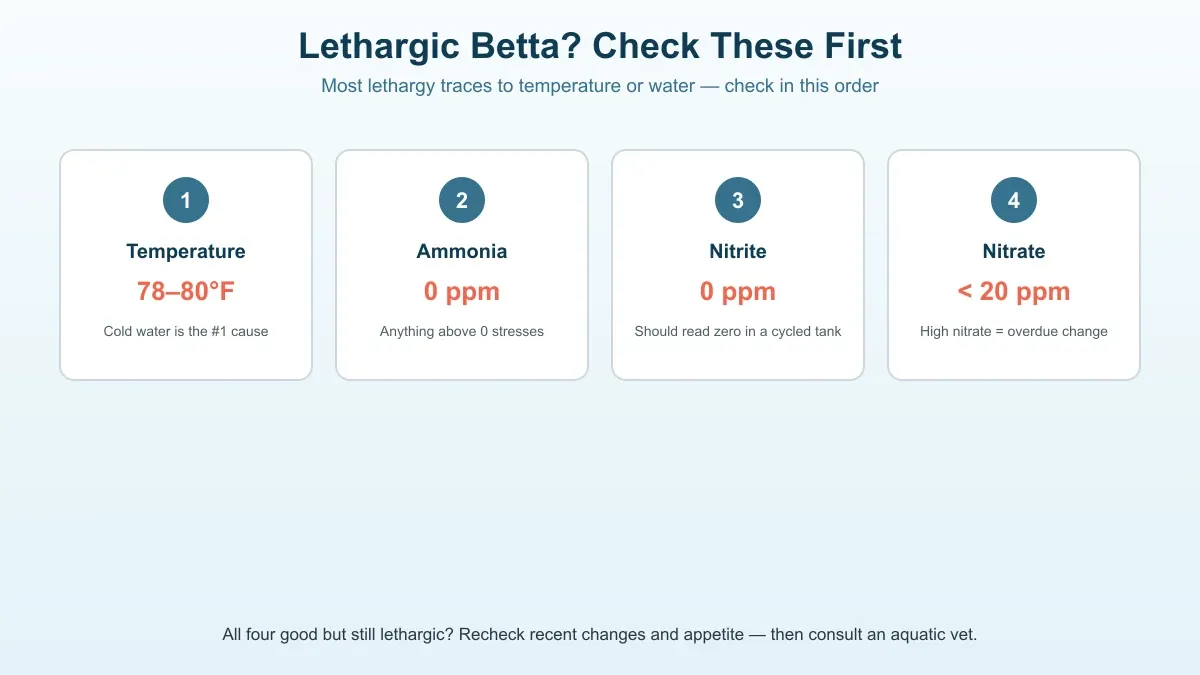
- 02 The 4-Step “Check This First” Flow
- 03 Cause #1: The Water Is Too Cold (Start Here)
- 04 Cause #2: Poor Water Quality (Ammonia and Nitrite)
- 05 Cause #3: New-Tank / New-Home Stress
- 06 Cause #4: Overfeeding and Constipation
- 07 Cause #5: Old Age
- 08 Cause #6: Illness (When Lethargy Is a Symptom)
- 09 When to Worry vs. When to Wait
- 10 Betta Lethargy Quick-Check Table
- 11 FAQ
- 12 Sources and Further Reading
Quick Answer: Resting, or Actually Lethargic?
Bettas are not constant swimmers. They nap, they perch on leaves, they rest near the bottom or wedged behind the filter — and a healthy betta does this several times a day. So stillness alone isn’t an alarm.
Here’s the difference. A resting betta breathes calmly, holds normal color and open fins, and perks up the moment you approach or drop in food. A lethargic betta stays slumped for most of the day, often with clamped fins, faded color, or fast gilling, and barely reacts when you come near the glass. That second picture — stillness plus other symptoms — is what’s worth investigating.
- Probably just resting if your betta is alert between naps, eats normally, has good color, and snaps to attention at feeding time.
- Worth investigating if the stillness is all-day, comes with clamped fins, color loss, gasping at the surface, or no reaction to you.
If you landed on the second bullet, don’t panic and don’t reach for medication yet. Work the ordered flow below first — it takes about ten minutes and rules out the cheap, common causes before the scary ones.
The 4-Step “Check This First” Flow
Run these in order. Most lethargy is solved by step 1 or step 2, so don’t skip ahead.
- 1 Temperature
Put a thermometer in the tank (or your hand on the glass). It should read a stable 78–80°F. Cold water is the #1 cause and free to rule out.
- 2 Water test
Test for ammonia and nitrite. Both should read 0 ppm. No test kit yet? Do a partial water change now (it’s a safe default) and read the “I don’t have a test kit” note below.
- 3 Recent changes
Did you just buy the fish, move tanks, rescape, relocate the tank, or do a big water change? Recent disruption points to stress, which fades on its own in a few days.
- 4 Appetite
Is it still eating? A betta that’s lethargic but eating usually has a better outlook. Lethargic and not eating is the higher-concern combo — keep that in mind as you read on.
Come back to this box anytime. The sections below explain each cause in plain English and tell you exactly what to do.
Cause #1: The Water Is Too Cold (Start Here)
Bettas come from the warm, shallow waters of Southeast Asia — they are tropical fish, full stop. When the water drops below about 76°F, their metabolism slows, their immune system weakens, and they do exactly what a cold-blooded animal does in the cold: go still and sit on the bottom. Beginners see this and assume illness, when the real fix is a heater.
A few traps catch new keepers constantly:
- No heater at all. A betta in unheated room-temperature water is almost always too cold, even if the room feels comfortable to you.
- “The room is warm, so the tank is warm.” Water holds and loses heat differently than air. The only way to know your tank’s temperature is to measure it.
- A heater that’s too small for the tank, or one that’s failed without you noticing.
- Overnight and seasonal drops — air conditioning, an open window, or a cold winter night can pull a small tank down several degrees while you sleep.
- Tiny bowls and nano tanks that swing temperature fast because there’s so little water to buffer them.
What to do: add an adjustable aquarium heater sized to your tank and verify with a thermometer — never trust the dial alone. Target a stable 78–80°F, which sits comfortably inside the 76–81°F range veterinary care references give for bettas (PetMD). If your tank is currently cold, raise the temperature gradually — roughly 1–2°F per hour — because a sudden swing is its own kind of shock.
Cause #2: Poor Water Quality (Ammonia and Nitrite)
Once temperature checks out, water quality is the next most likely culprit — and it’s sneaky because ammonia and nitrite are invisible and odorless. As fish waste and leftover food break down, they release ammonia. In a tank that isn’t fully cycled, ammonia and then nitrite climb to levels that stress and poison your betta. The fish responds by going lethargic, clamping its fins, and sometimes gasping near the surface.
This is especially common in brand-new setups, a problem hobbyists call New Tank Syndrome: the colony of beneficial bacteria that converts ammonia into less-harmful compounds hasn’t established yet, so toxins build up in the first weeks. A betta dropped into an uncycled tank can look sick within days when the water is the real problem.
What to do: test your water with a liquid test kit. Ammonia and nitrite should both read 0 ppm, and nitrate is best kept under about 20 ppm. If ammonia or nitrite is above zero, do a 25–50% water change right now with dechlorinated, temperature-matched water, then keep testing daily until levels hold at zero. Don’t scrub the filter or replace all the media at once — that wipes out the bacteria you’re trying to grow.
”I Don’t Have a Test Kit”
That’s okay — here’s the honest beginner path. A partial water change is a safe default even when you can’t measure anything: do a 25–50% change with dechlorinated, temperature-matched water tonight, and it will lower whatever toxins are present. Then buy two tools you’ll use for the life of your fish: a thermometer and a liquid test kit. Liquid kits cost a little more upfront than paper strips but are cheaper per test and noticeably more accurate, so you’re not guessing about the most important thing in the tank.
Cause #3: New-Tank / New-Home Stress
Did the lethargy start right after you brought the fish home, switched tanks, rescaped the decor, or moved the tank to a new spot? Bettas are sensitive to change, and a stressed fish often hides, sits still, or sulks for several days while it adjusts. This kind of lethargy usually resolves on its own once conditions settle.
Beyond a recent move, a few ongoing stressors can keep a betta withdrawn:
- Too-strong filter current — bettas have heavy fins and aren’t strong swimmers, so a powerful flow exhausts them and pins them down.
- A bare tank with nowhere to rest or hide leaves a betta feeling exposed.
- A high-traffic or noisy spot — next to a TV, a slamming door, or a busy hallway.
- Harsh, around-the-clock lighting with no consistent day-night rhythm.
What to do: give it warm, stable water; soften the filter flow if it’s whipping the surface around; and add silk or live plants plus a cave or leaf hammock so your betta has places to rest. Then give it a few quiet days. If your fish is specifically parked on the substrate, our guide on why your betta is laying at the bottom digs into that behavior.
Cause #4: Overfeeding and Constipation
A betta that’s been overfed can become constipated and bloated, and a backed-up fish gets sluggish and may settle at the bottom. This is one of the most common beginner mistakes, partly because dry pellets swell once they hit water and the stomach — what looks like a tiny portion in the jar becomes a lot more inside the fish.
Watch for a rounded or swollen belly, stringy waste, or a betta that’s clearly less active a day or two after a big feed. Bettas have small stomachs, so a good rule is 2–4 pellets, once or twice a day, and no more.
What to do: fast your betta for 1–2 days to let its system clear. After that, many keepers offer a small piece of blanched, deshelled pea or a couple of daphnia, which act as gentle fiber. A weekly fasting day helps prevent the problem entirely. If bloating comes with trouble staying upright or floating sideways, that points toward a swim bladder issue — see our betta swim bladder guide.
Cause #5: Old Age
Sometimes the answer is simply time. Bettas commonly live around 2 to 4 years, and many keep their fish toward the longer end of that with good care — but here’s the catch most beginners don’t know: pet-store bettas are usually already adults when you buy them. So a betta that slows down a year into your care may genuinely be a senior.
An aging betta naturally rests more, swims less, and can fade in color. That’s not a problem you can fix, and it’s not your fault — it’s the same gentle decline any animal goes through.
What to do: keep the water warm, clean, and stable, minimize stress, and offer easy-to-eat food. You can’t reverse age, but you can make a senior betta’s later months as comfortable as possible.
Cause #6: Illness (When Lethargy Is a Symptom)
If you’ve checked temperature, tested your water, ruled out a recent disruption, and addressed feeding — and your betta is still lethargic, especially alongside other symptoms — then illness moves up the list. Lethargy is a nonspecific sign that rides along with many betta health problems, so the goal here isn’t to self-diagnose; it’s to recognize that it’s time for help.
Symptoms that often accompany lethargy include:
- Clamped fins held tight against the body
- White spots like grains of salt (a sign of ich)
- Ragged or receding fins (fin rot)
- A swollen belly with scales sticking out like a pinecone (a serious sign often linked to dropsy)
- Trouble staying upright, floating, or sinking (swim bladder issues)
- Fast, labored gilling or gasping at the surface
A quick, honest note about who I am
I’m Maya Rivers — an experienced hobbyist and researcher, not a veterinarian. I can help you understand and rule out the common environmental causes, but I won’t diagnose disease or hand you a medication and dosage, because guessing with fish meds does real harm. If you suspect illness — or your betta doesn’t improve after you’ve fixed temperature and water quality — please consult a qualified aquatic veterinarian.
If your betta is also refusing food, our betta not eating guide covers that combination in more depth.
When to Worry vs. When to Wait
Pulling it together, here’s the simple call:
- Wait and monitor if your betta is eating normally, the water is warm and testing clean, and the stillness started right after a move or rescape. Give it a few quiet days and it usually bounces back.
- Act tonight if the water is cold, a water test comes back bad, your betta is not eating and clamped and still all day, or you see clear disease signs like bloating, pineconing scales, white spots, or gasping. Fix temperature and water first; if signs persist, call an aquatic vet.
Most environmental lethargy — cold water, poor water quality, stress, overfeeding — is fully recoverable when you catch it early and fix the root cause. Loop back to the 4-step flow anytime, and for the full foundation of keeping a betta thriving, start with our complete betta care guide.
Betta Lethargy Quick-Check Table
FAQ
Q.Is my betta dying or just sleeping/resting?
A resting or sleeping betta breathes calmly, keeps normal color, and perks up at feeding time or when you approach the glass — perfectly normal behavior several times a day. A dying betta tends to stay still all day, often gasps, loses color, may show clamped fins, and barely reacts to you. The combination of stillness and those extra symptoms is the real warning sign.
Q.Why is my betta not moving but still breathing?
Most often it’s cold water or poor water quality, not illness. Check the temperature (aim for 78–80°F) and test for ammonia and nitrite (both should be 0 ppm) before assuming the worst. A still-but-breathing betta is frequently a cold or stressed betta that recovers once conditions are corrected.
Q.How cold is too cold for a betta?
Below about 76°F a betta slows down and gets sluggish; below roughly 72°F is genuinely dangerous and stresses its immune system. Aim for a stable 78–80°F using an adjustable heater and a thermometer to verify.
Q.Can a lethargic betta recover?
Yes — when the cause is environmental (temperature, water quality, stress, or overfeeding) and you catch it early, most bettas bounce back once you fix the root cause. Recovery is less certain when lethargy is driven by advanced illness or old age.
Q.Should I do a water change if my betta is lethargic?
A 25–50% water change with dechlorinated, temperature-matched water is a safe first step, especially if you can’t test the water yet. It lowers any hidden ammonia or nitrite and rarely does harm, as long as the new water matches the tank’s temperature.
Q.My betta is lethargic and not eating — what does that mean?
This is a higher-concern combination than either symptom alone. Warm the water to 78–80°F, test it, and do a partial water change. If your betta still won’t eat and stays lethargic after conditions are correct, consult a qualified aquatic veterinarian rather than waiting it out. Our betta not eating guide walks through this pairing in detail.
Sources and Further Reading
- PetMD — Betta Fish Care Sheet — DVM-reviewed care, water temperature, and health basics.
- Merck Veterinary Manual — Aquarium Fish — general care and water quality reference.
Once your betta is active and alert again, keep it that way with stable, warm water and a sensible feeding routine. For the full picture, start with our complete betta care guide. 🐠