You’re standing over the tank wondering whether your betta is content or quietly miserable, and the internet keeps handing you one-sided lists. So let’s do it properly. Below is a side-by-side chart that lets you read your fish in about 30 seconds, then a plain-English breakdown of every happy and stressed sign — and a cause-to-fix table so you know exactly what to change.
In this guide
Quick Answer: How to Read Your Betta in 30 Seconds
Match what you actually see in the tank to the rows below, then jump to the matching fix further down. The trick is to look at the whole fish, not one detail. A betta taking a quick rest on a leaf isn’t stressed; a betta with clamped fins, faded color, and frantic pacing is telling you something’s wrong.
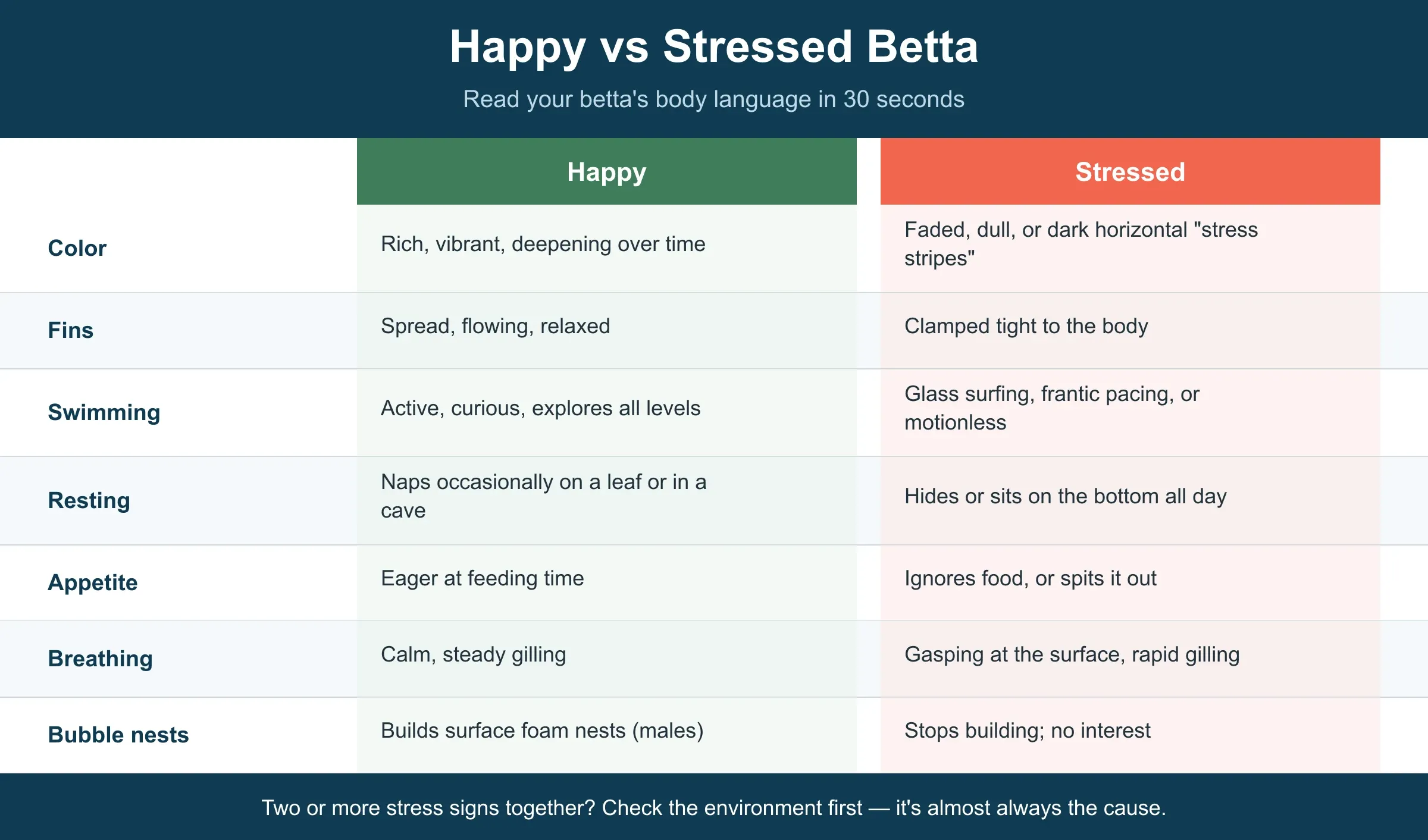
One relaxed sign on its own is reassuring. One stress sign on its own is rarely an emergency. But two or more stress signs together means it’s time to act — and almost always the culprit is the environment, not the fish.
5 Signs Your Betta Is Happy
A content betta is genuinely fun to watch. Here’s what “doing well” actually looks like.
Active, curious swimming
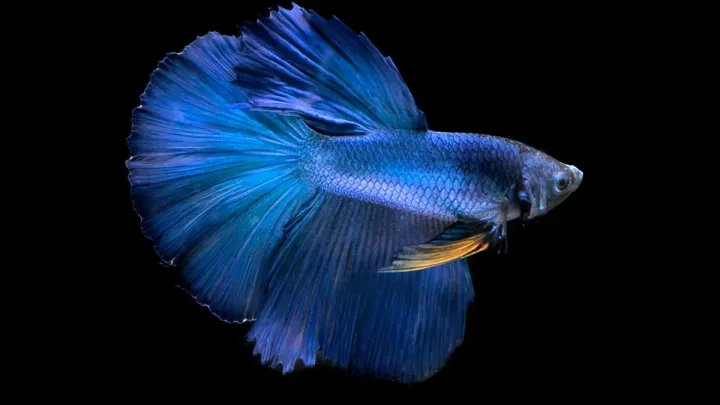
A happy betta patrols its tank. It explores the top, middle, and bottom, investigates new plants or decorations, and often swims over to greet you when you approach — many bettas learn to associate a person with feeding time. Smooth, purposeful movement through all levels of the tank is one of the clearest signs your fish feels safe.
Vibrant, rich color
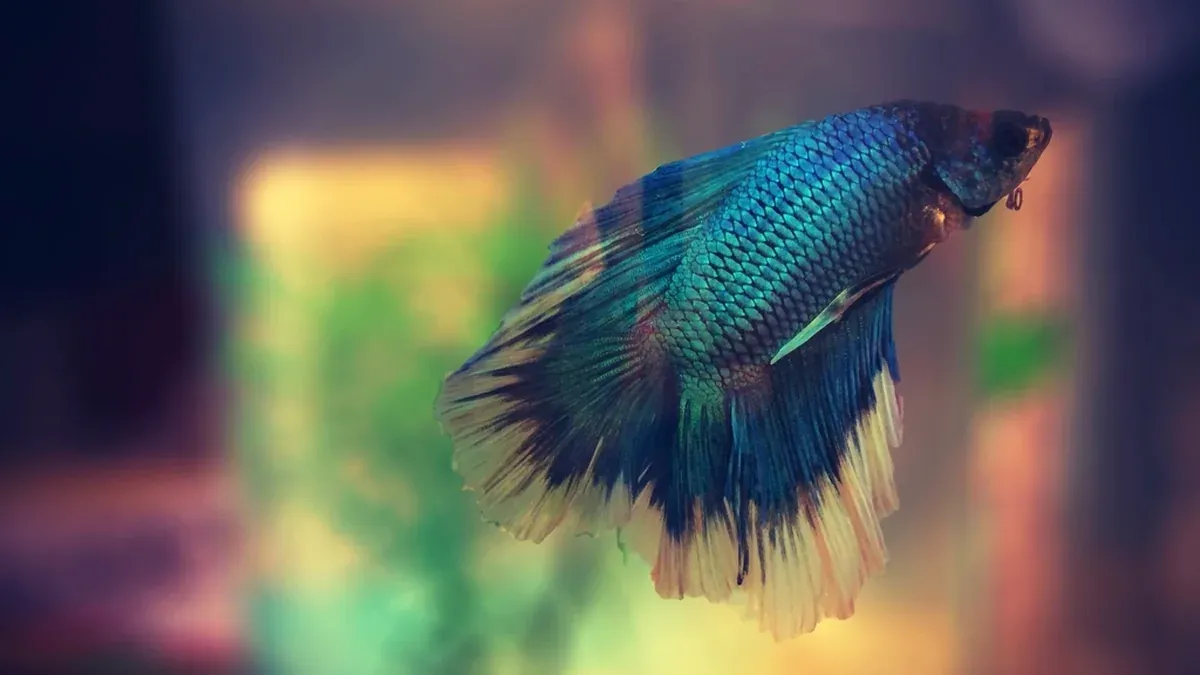
Good water and a varied diet deepen a betta’s color over the weeks after you bring it home. If your fish looks brighter and more saturated than it did at the store, that’s a strong vote of confidence in your tank. Color is one of the first things to dull when a betta is unhappy, so a betta that’s gaining color is a betta that’s settling in well.
Healthy appetite
A betta that rushes to the surface at feeding time and eats without hesitation is a happy betta. No drama, no spit-outs, no ignored pellets sinking to the bottom. A reliable appetite is one of the most dependable day-to-day signals that everything is on track. (If your betta has gone off its food, see why is my betta not eating.)
Gentle flaring and “showing off”
A betta that occasionally flares — puffing its gills and spreading its fins at its reflection, a tank mate, or you — is displaying normal behavior, not necessarily distress. A confident fish shows off. The thing to watch for is constant flaring, which can mean it’s seeing a stressor it can’t escape, like its own reflection on a glaring tank wall or a fish in the next pane.
Bubble nests
Clusters of foamy bubbles at the water’s surface are a classic good sign — a male betta building a nest is signaling that it feels confident and content enough to think about breeding. Note that females don’t usually build them, and plenty of perfectly happy males skip nest-building too. So treat a bubble nest as a bonus reassurance, never a requirement.
One more reassurance: a betta resting on a leaf, tucking into a cave, or taking a midday nap is completely normal. Bettas sleep and lounge. Resting with normal color and relaxed fins is not a stress sign.
7 Signs Your Betta Is Stressed
Now the other side. None of these alone is cause to panic — but the more of them you count, the more urgently your tank needs attention.
Stress stripes (dark horizontal lines)
Stress stripes are dark lines that run horizontally — head to tail, lengthwise along the body. They tend to show up more visibly on female bettas than males, and they signal that the fish is reacting to something it doesn’t like: a sudden change, poor water, a fright, or sometimes the early stage of illness.
Here’s the distinction most pages get wrong: horizontal lines are stress (or fear, or feeling unwell). Faint vertical bars on a female — running up and down across the body — are something different entirely: they’re usually breeding bars, a sign she’s ready to mate, not a sign she’s suffering. Direction is the tell. Horizontal equals stress; vertical bars on a female equal breeding readiness (Hepper).
Clamped fins
A relaxed betta holds its fins open and flowing. A stressed one clamps them — pinned tight against the body so the fish looks smaller and less impressive than usual. Clamped fins are one of the most reliable distress signals, and they very often point to a water-quality or temperature problem.
Glass surfing
Glass surfing is frantic, repetitive up-and-down swimming against the front pane of the tank. A little exploring of the glass is fine, but persistent pacing usually means boredom, a too-small or too-bare tank, a tank mate or reflection it can’t get away from, or new-tank stress.
Hiding or sitting on the bottom all day
Occasional hiding is normal; all-day hiding is not. A stressed betta may wedge itself behind decor or lie on the substrate for hours, often with clamped fins and dull color. The difference between a nap and a problem is the rest of the picture — color, fins, and whether the fish perks up when you approach. (More on this in our guide to a betta laying at the bottom.)
Gasping at the surface or rapid gilling
If your betta hangs at the surface gulping air far more than usual, or its gills are pumping fast, treat it as a red flag. Bettas breathe air from the surface normally thanks to their labyrinth organ, but constant gasping often signals low oxygen or — more commonly — ammonia in the water irritating the gills. This one earns a water test today.
Faded or dull color
A gradual loss of vibrancy over days, with the betta looking washed-out compared to last week, is a classic stress response. (A betta turning patchy white with fuzzy or textured spots is a different, more medical situation — that’s illness territory, not plain stress.)
Lethargy and loss of appetite
A sluggish betta that ignores food, barely moves, and seems “switched off” is showing two stress signs at once. Lethargy plus a refused meal is a strong prompt to check temperature and water quality immediately — our guide on why your betta is lethargic walks through the order to check things.
The rule of thumb: one sign is a nudge to keep an eye on things. Two or more together — say, clamped fins and faded color and hiding — means act now. Start with the cause-to-fix table below.
What Causes Betta Stress — and How to Fix Each
Stress is almost always the environment, not the fish. The good news is that environmental problems are fixable. Find your likely cause in the table, then read the matching note below it.
Wrong water temperature
Bettas are tropical fish that need warm, stable water — the widely recommended sweet spot is 78–80°F (roughly a 76–82°F working range), and stable matters as much as the number (Chewy). Cold water slows their metabolism and makes them sluggish and stressed. Fix: use an adjustable aquarium heater with a thermometer to confirm it. Never rely on room temperature — this is the single most common beginner miss.
Poor water quality
Ammonia and nitrite are invisible and toxic. In an uncycled tank, fish waste breaks down into ammonia that builds up and irritates the gills, which is why a “clean-looking” tank can still be stressing your fish. Fix: cycle the tank, test weekly with a liquid kit (ammonia and nitrite should read 0 ppm), do regular partial water changes, and always treat tap water with a dechlorinator.
Tank too small
Sub-5-gallon “betta bowls” and decorative vases look cute and cause chronic stress — small volumes swing in temperature and foul fast. Fix: give your betta a minimum of 5 gallons. More water is more stable water, and stability is what keeps a betta calm.
Strong filter current
Bettas have long, flowing fins and aren’t strong swimmers, so a powerful filter outflow can leave them battling the current all day. Fix: baffle the outflow (a simple sponge over the nozzle works) or switch to a gentle or sponge filter.
Tank mates or another betta
Two male bettas will fight, and many “betta-safe” tank mates still stress a betta that can see them constantly. Fix: never house two bettas in the same tank, research any tank mate’s compatibility before adding it, and use plants and decor to create sight breaks and hiding spots.
New tank or recent change
If you just brought your betta home, moved it, or rescaped the tank, a week or two of stress behavior is normal. Fix: be patient, keep conditions stable, and make any corrections gradually — change one variable at a time so the fix itself doesn’t pile on more stress.
How Long Until My Betta De-Stresses?
Recovery isn’t instant, but it’s usually quick once the cause is gone. New-environment stress typically settles within 1–2 weeks of stable, correct conditions. Stress stripes generally fade within a few days to a couple of weeks after you remove whatever triggered them.
The key is patience and a light touch: change one thing at a time, and make corrections slowly. Slamming the heater up overnight or doing a 90% water change to “fix” things fast just adds a new shock. Steady, stable, and gradual is what your betta needs to bounce back.
When It’s More Than Stress
When to consult a vet
If your betta still shows stress signs despite correct temperature, cycled water, and a properly sized tank — or you spot physical disease signs like white spots, cottony patches, ulcers, bloating, or ragged fins — it may be illness rather than plain stress. That’s the point to consult an aquatic or exotics vet.
Finned Friends helps you read your fish and rule out the common environmental causes, but we’re hobbyists and researchers, not veterinarians. When signs persist after you’ve got the basics right, or anything looks physically wrong, a professional is the right call.
FAQ
Q.What do betta stress stripes look like?
Dark horizontal lines running head-to-tail along the body — more visible on females than males. Note that faint vertical bars on a female usually mean she’s ready to breed, not that she’s stressed. Direction is the giveaway: horizontal is stress (or fear/illness), vertical bars are breeding readiness.
Q.How long does it take a betta to de-stress?
Typically 1–2 weeks after you fix the cause and keep conditions stable. Stress stripes themselves often fade within a few days to two weeks once the trigger is gone.
Q.Is my betta stressed or just resting?
A quick nap on a leaf or in a cave, with normal color and relaxed fins, is completely fine — bettas rest. It’s stress when you also see clamped fins, faded color, or hiding all day long.
Q.Why is my betta glass surfing?
Frantic pacing along the front glass usually means boredom, a too-small or too-bare tank, a tank mate or reflection it can see, or new-tank stress. Add plants and hiding spots, and check the tank size and surroundings.
Q.Can a stressed betta die?
Prolonged stress weakens a betta’s immune system and can lead to illness or death, so it’s worth fixing the cause promptly. The reassuring part: a quick, full recovery is normal once conditions are right.
Q.Do happy bettas always build bubble nests?
No. Bubble nests are a great sign in males, but plenty of healthy, content bettas don’t build them — and females usually don’t at all. A betta that isn’t nesting can still be perfectly happy.
Sources & Further Reading
- Hepper — Betta Fish Stress Stripes — what stress stripes look like and what they mean.
- Chewy — Betta Fish Water Temperature — recommended temperature range and stability.
Reading your betta is a skill you build fast: watch the color, the fins, and the swimming, and you’ll know within a glance whether your fish is thriving. For the full setup that keeps a betta happy long-term, start with our complete betta care guide. 🐠